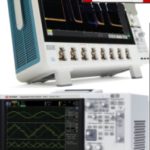
Rigol’s DSA815 Spectrum Analyzer

The new DSA815 spectrum analyzer from Rigol Technologies, Inc., features all-digital IF technology virtually eliminating errors that occur when using traditional analog IF designs, covers a frequency range of 9kHz to 1.5 GHz, a compact design and easy-to-use interface with a reliable spectrum analyzer for the cost of a digital oscilloscope. The analyzer has a wide range of standard functions including AM/FM demodulation and a preamplifier, plus a variety of optional enhancements such as an EMI filter and quasi-peak detector kit and a 1.5 GHz tracking generator. As a result, the DSA815 is easy to use and highly reliable in even the most demanding RF applications.

DSA815PRhr Spectrum Analyzer

Having a typical displayed average noise level (DANL) of -135 dBm, offset phase noise of -80 dBc/Hz @10 kHz and a total amplitude uncertainty of <1.5 dB, makes the analyzer ideal for benchtop or field apps in RF and wireless testing and production. With digital IF design technology, it allows users the ability to measure smaller signals by enabling smaller bandwidth settings, which greatly reduces the displayed average noise level. A minimum resolution bandwidth (RBW) of 100 Hz gives the analyzer the ability to distinguish between small signals close in frequency.

The Tracking Generator option provides a complete additional set of functionality. Use the instrument as a VSWR tester with a bridge or simply connect to test passive and active RF components. The Generator will also function as a static signal source generator from 10 MHz to 1.5 GHz by setting the Spectrum Analyzer to zero span mode.

Rigol Technologies, Inc.

http://www.rigolna.com/

Ultrasonic Tester Designed For Labratory Use

September 22, 2010 by  
Filed under Bench Test, Meters & Testers, Test Equipment

The Pundit Lab has all the functions of the classic Pundit 7, but offers additional benefits. Designed with labora­tory use in mind, its compact size, rugged construction and optimized power consumption make it equally suit­able for on-site use.

Along with the traditional transit time and pulse velocity measurement, Pundit Lab offers path length measure­ment, perpendicular crack depth measurement and surface velocity measurement.

Optimized pulse shaping gives greater transmission range at lower voltage levels. This coupled with automated combination of the transmitter voltage and the receiver gain ensures an optimum received signal level ensuring accurate and stable measurements.

The waveform can be viewed either via an external oscilloscope connection or directly on a connected PC screen.

Full remote control capability completes the package.

ultrasonic tester

Benefits

Remote Control: A USB connection and the Pundit Link application allow full remote control of all Pundit Lab features, on-line data acquisition, waveform analysis, manual triggering and data upload.

Versatility: Basic measurements of pulse velocity or path length. Compound measurements of crack depth and surface velocity. Non volatile storage and download to PC is ideal for uniformity testing.

Multiple Power Supply Options: Pundit Lab runs on battery supply, mains supply via AC adaptor and can also be powered from a PC via the USB connection.

Wide range of transducers: Pundit Lab supports a wide range of transducers from 24 kHz up to 500 kHz, mak­ing it suitable not only for concrete and rock, but also for other materials such as graphite, ceramics, wood, etc.

www.gardco.com

Cryogenic Mass Vortex Flow Meters Measure Fluids Down To -328°F

August 6, 2010 by  
Filed under Bench Test, Meters & Testers

In an effort to provide an advanced and more reliable measurement system to the liquefied gas measurement market, Sierra Instruments has introduced a new cryogenic version of their Innova-Mass® multivariable mass vortex flow meter. This application has been historically serviced by the turbine flow meter, however given that the multivariable mass vortex meter has no moving parts to wear out or be serviced, the benefit of the instrument is a more reliable, stable reading and an increased service life.

cryogenic flow meter measures cold liquids

The new Innova-Mass cryogenic version has undergone extensive testing and field validation over the last several years proving that the meter is preferred versus traditional turbine meters for measuring mass flow rates of cryogenic fluids down to -328°F (-200°C). Using a special cryogenic temperature RTD, mass calculations are done with the latest density equations of state for liquid Oxygen, Nitrogen, Argon, and CO2.

The Innova-Mass Model 240 and Model 241 measure five process variables (mass flow, volumetric flow, temperature, pressure and density) through one process connection. Since everything is calibrated together, system accuracy is very high. Because mass flow is directly measured, the Reynolds number can be dynamically calculated and the flow profile effects in large pipes calculated in real time. This allows Sierra’s unique insertion Model 241 to make reliable measurements in large pipes (up to 72 inches) where using an in-line meter would be cost prohibitive.

The Innova-Mass is loop-powered, with power in, a programmable analog output and a HART or MODBUS signal riding on the same two wires.

www.sierrainstruments.com

Dimensional Metrology System Provides Five-Axis Measurement Capability

July 1, 2010 by  
Filed under Bench Test, Meters & Testers

Optical Gaging Products (OGP®) released its programmable five-axis measuring for its large-measurement-volume dimensional metrology system, SmartScope® Quest™ 650. A motorized heavy-duty dual rotary indexer allows SmartScope Quest sensors to measure features anywhere on the most complex parts. OGP MeasureMind® 3D MultiSensor metrology software supports simultaneous five-axis motion, keeping the coordinate system aligned with the rotating part. This automatic system accurately measures complex parts such as turbine blades, vanes, and airfoils.

SmartScope Quest 650 was designed from the ground up for precision metrology at accuracies unparalleled in the industry, and features high-speed linear motors, a 610x660x400 mm (24x26x16″) XYZ measurement volume, patented completely telecentric TeleStar® metrology zoom optics, and a massive granite stage and thermally stable Meehanite® bridge for enhanced metrological integrity. Quest 650 supports video, touch trigger probes, laser scanners, and micro-probes, and can also be equipped with the optional SP25 scanning probe to automatically acquire surface data points via continuous contact between user-defined start and end points. Feather Probe(TM) adds micro-probing capability with milligram-level probing pressure for small features on fragile or sensitive parts. The Rainbow Probe(TM) scanning white light sensor characterizes Z-axis topography to the nanometer level. The unique long-working-distance interferometric TeleStar TTL (through-the-lens) laser, as well as the off-axis DRS(TM) laser, provide non-contact surface contour scanning. All sensors are available under program control, all are calibrated to a common reference frame within MeasureMind 3D MultiSensor, and all can be used interchangeably within the same measurement program.

Optional software includes SmartFit® 3D, a fast and accurate 2D/3D best-fitting and analysis software that optimizes the value of measurement data; SmartProfile(TM), a 3D best-fitting software package used in a GD&T environment; as well as software for SPC, 3D CAD import, and custom report writing.

Optical Gaging Products (OGP®)
www.ogpnet.com

Non-Contact Measurement System Fits On Any Benchtop

The StarLite™ GX, from RAM Optical Instrumentation, Inc. (RAM), is a compact non-contact measurement system with a unique ergonomic design, motorized zoom optics, color camera, and ample 6″ x 3″ x 5″ XYZ capacity. StarLite GX is small enough to fit on any workbench, yet large enough for routine inspection and measurement – a welcome difference.

StarLite GX is built for precision measurement, with a sturdy cast aluminum base and column, precise coarse/fine manual stage positioning, and one-micron resolution linear scales. Its high fidelity white ring light and back light illuminators provide optimal image quality.

New feature-packed eGx(TM) metrology software allows every user to get accurate and repeatable dimensional measurements easily. Measure directly or run part programs that guide every user through the measurement process. Easy to measure – Automatic measurements without motors.

RAM Optical
www.ramoptical.com

Universal DAQ System Has Eight Individual Analog Voltage Outputs

Many test and measurement tasks require measured physical parameters to be output as a standardized voltage. For these applications, HBM released the MX878 output module – a new module of the flexible and powerful QuantumX data acquisition system.

HBM's blue quantumX data acquisition systemThe output module has eight analog voltage outputs that can be individually configured. The module enables system signals to be output as scaled and filtered values in the range of ±10 V. All signals supplied by the amplifiers can be used as signal sources. This makes individual monitoring or forwarding of system signals such as measured values very easy.

In addition, the module offers integrated local intelligence that enables measured values to be analyzed or set off against each other in real time using algebraic operations. The module also features functions for the computation of peak value or root mean square value. Computed signals can be made available in the system in real time or the can be output directly.

The functions or outputs can be configured directly using QuantumX Assistant software, LabView® VIs or the user’s individual programs via the integrated QuantumX programming interface (API) for .NET or COM. catmanAP software provides comprehensive options for configuration, data acquisition, visualization and analysis.

Typical fields of application of the new MX878 QuantumX module include for example test bench applications involving conversion of various transducer signals.
Further information at

www.hbm.com

Model MG Liquid Level Transmitter Meets API Standards

The Level Plus Model MG liquid transmitter manufactured by MTS Sensors meets the requirements for the custody transfer standard as set forth by the American Petroleum Institute (API). The model MG level transmitter conforms to the Manual of Petroleum Measurement Standards’ requirements in Chapter 3, Section 1B, for inherent and overall installed accuracy of an automatic tank gauge. To validate conformity MTS tests 100% of all Model MG level transmitters on a state-of-the-art laser test bed that is traceable to the National Institute of Standards and Technology (NIST) standards. The maximum allowable nonlinearity is 1/16 in. to pass the laser test bed and to conform to the API custody transfer standard.

“As the world leader in magnetostriction, the accuracy of the Level Plus Model MG not only outperforms our magnetostrictive competitors, but also ultrasonic and radar technologies as well,” says Lee Aiken, Product Marketing Manager, MTS Sensors. “MTS continues to be a market leader in automatic tank gauging through investment in our core Temposonics technology, which is an advancement of magnetostrictive technology. These advancements translate into a highly accurate and easy to use level transmitter for our customers. MTS stands behind the performance of our level transmitters with certificates of conformity to AAPI standards, which state the inherent accuracy of a specific level transmitter. When MTS states a specification about accuracy, repeatability, and so forth, our customers know that we can meet it.”

The Model MG level transmitter satisfies the demand for a digital communications interface in the liquid level marketplace for vessels from 508 mm (20 in.) to 22,000 mm (866 in.) high. Outputs for the Model MG include Modbus, DDA (proprietary ASCII protocol), and FOUNDATION fieldbus. The Model MG level transmitter features 3-in-1 measurement of the product level, interface level, and the average temperature from one to 12 temperature points. This product feature lets customers use a single process opening, which eliminates the need for separate level and temperature transmitter openings and products. Designed for inventory control, the Model MG level transmitter is accurate to at least 1/16 in. at maximum length and can provide volume measurement from a 100-point strap table that the user loads into the transmitter. By incorporating the strap table into the transmitter, the user does not need to maintain multiple copies of the strap table or create the underlying formulas.

MTS Sensors Division
www.mtssensors.com

Digital Multimeter Has USB & Cable Adapters

January 18, 2010 by  
Filed under Bench Test, Meters & Testers

Fluke Corporation announced enhancements to its bench digital multimeters. The Fluke 8808A 5.5 digit Digital Multimeter and the 8845A/8846A 6.5 digit Multimeters will now include a USB to RS232 Cable Adapter as well as FlukeView Forms Basic software.

www.fluke.com

Dual Range Portable Pressure Calibrators

December 2, 2009 by  
Filed under Bench Test, Meters & Testers

DH-Budenberg says the H542 / P542 family of Bench-top, Portable Calibrators are available as single range or dual range units, which can be optimised to suit individual requirements.

According to the company, the Portable Pressure Calibrators a powerful range of instruments providing optimum features for industrial users, whilst being user friendly and rugged enough for industrial environments.

Portable PressureThe H542 / P542 instruments are suitable for high accuracy measurement of pressure, along with built-in means of raising and adjusting the pressure. On both models, up to two internal sensors can be fitted for a wide operating range, with storage of test data for download and printing of certificates.

DH-Budenberg says the H542 Hydraulic unit features a pressure control which enables rapid priming at low pressure, as well as fine adjustment at high pressure, without the need for additional priming pumps. Hydraulic Pressure ranges from 0 to 100bar and various ranges up to 2,500bar (250MPa).

The P542 Pneumatic unit is said to require gas supply slightly in excess of the maximum test pressure, the gas supply should be clean and dry, such as nitrogen. Pneumatic Pressure ranges are from vacuum to 2.5bar / 250kPa, up to 100bar /10,000kPa.

High Resolution Digitizer for Defense Markets

October 16, 2009 by  
Filed under Bench Test, New Articles

Agilent Technologies introduces its Acqiris product line’s highest-resolution VME/VXS digitizer. The SVM4800 is an eight-channel 14-bit digitizer with more than 300 MHz input signal bandwidth, achieving sampling of up to 125 MS/s. This new digitizer is ideal for applications in radar, Electronic Warfare (EW) and Synthetic Instrumentation (SI).High-Resolution-Digitizer's

The Agilent SVM4800 builds on the modular U1083A VME/VXS base card with an analog digitizer mezzanine that includes two DC-coupled 14-bit, 125 MS/s quad-ADCs. Agilent know-how in digitizer development combined with extensive use of state-of-the-art technology allow reaching outstanding analog performance, including spurious free dynamic range (SFDR) of up to 82 dBc, total harmonic distortion (THD) of 82 dBc, and signal to noise ratio (SNR) over 70 dBc, leading to an effective resolution of more than 11.2 bits (ENOB) at 125 MS/s. The mezzanine also includes a Xilinx Virtex-5 FPGA that provides data MUX function and static data gain and offset correction.

The base card provides high-performance, real-time data processing by means of two very large Xilinx Virtex- 4 FPGAs, one SX55 and one FX100. The board supports eight 3.125 Gbps serial links on the VXS backplane and two optical links on the front panel supporting up to 3.125 Gbps, providing a substantial aggregate data bandwidth of more than 3.5 GB/s. Its fully compliant VME64x interface supports the 2eSST protocol.

An optional firmware development kit (FDK) is available to help application firmware implementation on the SX55 and FX100 FPGAs. The FDK includes a set of cores to easily interface to the underlying hardware, a base design for each family member to provide very simple, ready-to-use designs, and a test-bench environment for design and simulation.

This product is intended benefit those charged with closing the gaps in emerging threats through new technology or by refreshment of fielded Electronic Support (ES), Electronic Attack (EA) and Electronic Counter Measure (ECM) systems, the majority of which are based on the ubiquitous VME architecture. Longer emitter identification standoff ranges, more precise direction finding in dense emitter environments, and shorter defensive engagement cycles are possible with relatively low incremental development cost. Wideband radar and intelligence-gathering systems are also expected to benefit, with better clutter rejection, range and target differentiation now attainable without massive reinvestment.

Next Page »