USB DAQ Box Offers Galvanic Isolation Of Input Signals
August 14, 2010 by admin
Filed under Calibration, data acquisition
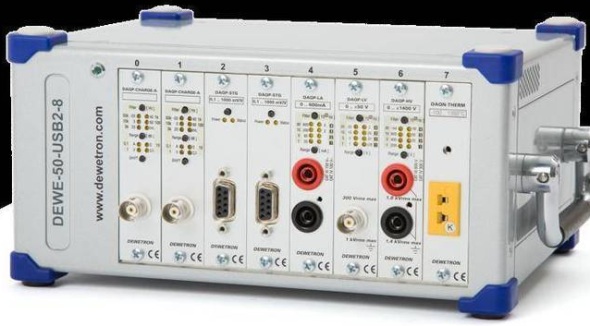
The DEWE-50-USB2-8 brings unprecedented power to USB data acquisition. There are a lot of USB based data acquisition instruments on the market today, but few of them provide real galvanic isolation of the input signals. Isolation is essential to protecting the test engineer and equipment from the effects of ground loops and high common mode voltages.
Most of the new crop of USB boxes emphasize low cost and convenience, but they achieve this by skipping real signal conditioning for serious data acquisition applications.
The DEWE-50-USB2-8 from Dewetron changes this completely, taking a fresh approach to USB data acquisition, incorporating real plug-in signal conditioning modules for low and high voltages, strain, pressure, acceleration, sound, temperature, force, and more.
The DAQP-HV high voltage module, for example, has selectable input ranges from ±20V to ±1400V (AC or DC), has a bandwidth of 300 kHz, and real galvanic isolation of 1800 Vrms. Therefore it can be used in demanding high voltage environments safely and with excellent performance. With this kind of isolation the test engineer can forget about CMV and focus on making the measurement.
The DEWE-50-USB2-8 has a powerful digitizer inside which features eight separate 24-bit ADCs – one per analog channel, for simultaneous sampling of all channels with very high resolution on the vertical axis. 24- bit resolution provides the test engineer the luxury of such a high dynamic range that he or she can use a single gain setting for a widely varying signals, and still get great resolution recordings.

Any combination of 8 DAQP series plugin modules plug into the front of the small DEWE-50-USB2-8 box, while the rear panel provides several more inputs:
o Two synchronous counter inputs, which can handle a wide variety of encoders and tachometers
o Each counter can alternatively be used as three digital inputs, for recording multiple bi-state TTL “event” inputs
o Two high speed CAN BUS interfaces, so that you can connect up to the data buses in all kinds of cars, trucks, aircraft, trains, and more. Everything is recorded synchronously to a single data file within DEWESoft
The rear panel also contains the DC power input connector, because the system runs from 10-30 VDC directly (AC/DC adapter and line cord is included). There is also a locking USB connector, of Dewetron’s own design, so that it cannot be pulled out of the chassis by accident. Conditioned analog outputs from the inputs are also available as an option, so you can access ±5V outputs from each of them.
Countless uses…
Power plants, flight test, train testing, automotive testing, factory troubleshooting…
Power plant testing
From rod control and rod drop testing in nuclear plants, to walk-around
trouble-shooting in a wide variety of applications. Advanced uses: 1-phase
and 3-phase – all power quality properties are calculated in real time
and displayed graphically. Easy report generation.
Flight test
Add ARINC 429 and MIL-STD-1553 interfaces, as well as IRIG time code and PCM data inputs to this Dewetron system, creating a powerful flight test data acquisition recorder.
Train test
New car inspection, speed tests, braking and emergency braking applications, using GPS, video and other speedometer sensors.
Automotive test
Drivability, Road load testing, CAPS and related applications, pass-by noise
tests, and all manner of in-vehicle and test cell applications.
Factory trouble-shooting
Machine diagnosis, shock and vibration testing, thermovac chambers,
and hundreds of physical measurement test and measurement applications.
Channel Expansion You can also plug in a second DEWE-50-USB2-8 to this one using the SYNC and USB DEVICE interface.
The system runs from 9-36 VDC power, and a convenient AC/DC converter is
included so that you can power the system from standard 120 VAC or 240 VAC power.
Plug-in Modules
There are DAQ series plug-in modules available which can handle a wide variety of sensors, including the DAQP-STG, developed by Dewetron for NASA, who have more than 1000 of these modules. The DAQP-STG can handle any kind of DC strain gage, voltages, resistive and ohmic measurements natively, and with the addition of our MSI plug-in interfaces, can additionally handle IEPE accels and mics, charge sensors, 200V, and more. This module has a bandwidth of 300 kHz.
If you don’t need such high performance, a lower cost version is available called the DAQP-MULTI, which can directly handle bridge, resistance, thermocouples, and RTDs, at a more attractive cost per channel.
The DAQP-HV is a high voltage module with ranges up to ±1400V, and the DAQP-LV low/medium voltage module with ranges from ±10 mV to ±50V, and still with high isolation. The DAQP-ACC-A is a 300 kHz bandwidth IEPE (ICP) signal conditioner amplifier which powers microphones and accelerometers.
Of course, CHARGE sensors are also supported with the DAQP-CHARGE-A and -B modules. Several other DAQP series modules are available for frequency to voltage, and other kinds of sensors.
Software
When you install the DEWE-50-USB2-8 on your computer, in addition to the driver,
Dewetron’s award winning DEWESoft data acquisition software will be installed.
DEWESoft provides incredible graphical control over the user interface, from system
setup through screen design, acquisition, triggering, and replay.
Version 7 now includes many more capabilities in the analysis mode. Data files can be processed using a wide range of math functions, from programmable filtering, (statistical analysis, integration and differentiation, and much more.
Standard displays include strip chart recorder, scope, digital and analog meters, FFT, and tabular numeric displays. You can connect video cameras to your computer and record video in sync with the data, adding a whole new level of understanding to it.
Software options are available for 3-phase power quality analysis, modal analysis, sine processing order tracking, torsional vibration, sound level meter, and many more advanced capabilities.
Size/performance
Instruments like the DEWE-50-USB2-8 are commonly sold at a much higher price point due to their isolation, 200 kS/s/ch sample rate, and 24-bit resolution.
Instruments like this are usually also much larger and occupy a bigger footprint than the DEWE-50-USB2-8.
New USB DAQ Devices From NI Useful For Multiple Applications
August 9, 2010 by admin
Filed under Calibration, data acquisition
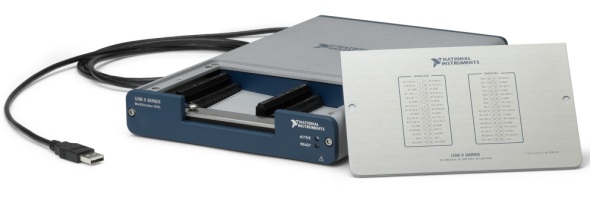
National Instruments announced NI X Series multifunction data acquisition (DAQ) devices for USB. USB X Series devices integrate high-performance analog measurement and control channels, digital I/O and counter/timers onto a single plug-and-play device, which engineers and scientists can use for a wide variety of portable test, measurement and data-logging applications. USB X Series DAQ devices include up to 32 analog inputs, four analog outputs, 48 digital I/O lines and four counters. The eight new devices range from 500 kS/s multiplexed AI to 2 MS/s/channel simultaneous sampling AI.

NI LabVIEW graphical programming makes it easy for engineers and scientists to develop completely custom test and measurement applications for USB X Series using intuitive graphical icons and wires that resemble a flowchart. LabVIEW 2010 simplifies data logging and analysis with a new technical data management streaming option within the NI DAQ Assistant and the ability to export data from a waveform graph to Microsoft Excel or NI DIAdem for post processing. USB X Series devices use the same multithreaded NI-DAQmx driver software as other National Instruments DAQ devices, making it easy to port LabVIEW or text-based code from previous applications for use with X Series.
USB X Series devices include two key technologies that make them as powerful as they are easy to use: NI-STC3 technology for advanced timing and triggering and NI Signal Streaming for high-speed, bi-directional data streaming.
At the core of all USB, PCI Express and PXI Express X Series devices is NI-STC3 timing and synchronization technology, which coordinates the timing and triggering of the analog, digital and counter subsystems. NI-STC3 technology provides X Series devices with independent timing engines for the onboard analog and digital I/O subsystems, making it possible for analog and digital I/O to execute independently at different rates or together with synchronization. X Series devices include four enhanced 32-bit counters for frequency, pulse-width modulation (PWM) and encoder operations, as well as a new 100 MHz timebase that can generate analog and digital sampling rates with five times better resolution than previous devices.

USB X Series devices include NI Signal Streaming, a patented technology that uses message-based transfers and device-side intelligence to deliver high-speed, bidirectional data transfer over USB, making it possible to perform analog, digital and counter operations concurrently. With this technology, simultaneous sampling now is available on two new devices, which can sample at 1.25 MS/s and 2 MS/s on each of their eight analog inputs. These devices are available with 32 or 64 MS onboard memory to guarantee finite acquisitions even with heavy USB traffic. The high sampling rates on all channels make these devices well suited for portable ultrasonic test and transient recording applications.
Each USB X Series device features a redesigned, extruded aluminum enclosure. The new enclosure offers an easy-access lid to keep signal wiring secure and shielded, and device-specific pinout labels on the lid make it possible to quickly determine the corresponding screw terminals for a given channel. The enclosure also includes a lockable USB port to prevent accidental removal during operation.
New Ethernet Data Acquisition Platform From NI
August 4, 2010 by admin
Filed under Calibration, data acquisition

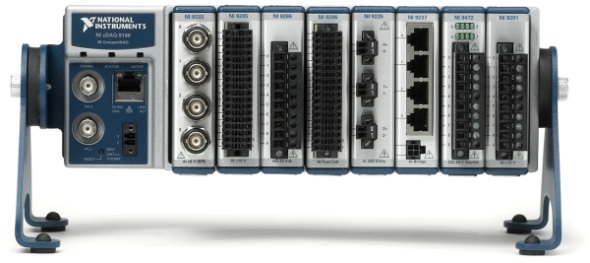
NI CompactDAQ is an easy-to-use, complete data acquisition system for mixed-signal and sensor measurement.
National Instruments announced the new Ethernet-based NI CompactDAQ modular data acquisition system, which combines the ease of use and low cost of a data logger with the performance and flexibility of modular instrumentation. The new NI cDAQ-9188 chassis is designed to hold eight I/O modules for measuring up to 256 channels of electrical, physical, mechanical or acoustic signals in a small (25 by 9 by 9 cm), rugged form factor. With more than 50 different I/O modules to choose from, engineers and scientists can build remote or distributed, high-speed measurement systems using standard Gigabit Ethernet infrastructure. In addition, NI CompactDAQ simplifies initial setup with zero configuration networking technology and a built-in, Web-based configuration and monitoring utility.

A locking data cable and screw terminal-based power connector option make using NI CompactDAQ off the benchtop easier.
The flexibility of Ethernet allows users to more easily standardize their test systems by eliminating many of the physical constraints required by more traditional PC interfaces.
NI CompactDAQ uses patented NI Signal Streaming technology to deliver high-bandwidth data over Ethernet to a host computer. NI Signal Streaming provides the ability to maintain bidirectional analog and digital waveforms continuously over a TCP/IP connection. With NI-STC3 timing and synchronization technology, each chassis also can manage up to seven separate hardware-timed I/O tasks at different sample rates, including analog I/O, digital I/O and counter/timer operations. The chassis operate in a temperature range of -20 to 55 degrees Celsius and can withstand up to 30 g shock and 3 g vibration, making NI CompactDAQ ideal for demanding test applications on the benchtop, in the field or on the production line.
In addition to the Ethernet chassis, the NI CompactDAQ platform includes a four- and an eight-slot USB chassis and NI C Series I/O modules. NI offers more than 50 C Series modules to use interchangeably in NI CompactDAQ systems, each of which is hot-swappable and auto-detectable for simplified setup. C Series modules offer integrated signal conditioning and multiple connectivity options to create custom, mixed-measurement systems specific to the needs of an application. A single analog input module, for example, can acquire up to four channels of simultaneous 1 MS/s voltage inputs for measuring high-speed signals such as ballistic pressure or ultrasonic transducers.

These NI C Series modules are shown in a variety of chassis and carriers for USB and Ethernet.


You can choose from more than 50 NI C Series measurement modules
NI-DAQmx driver software, which is included with NI CompactDAQ, goes beyond a basic device driver to deliver increased productivity and performance. With NI-DAQmx, engineers and scientists can log data for simple experiments or develop a complete test system in NI LabVIEW, NI LabWindows™/CVI, ANSI C/C++ or Microsoft Visual Studio .NET. Furthermore, a consistent API means that an application developed for an NI CompactDAQ USB chassis will work with an NI CompactDAQ Ethernet chassis without any changes to software.
Programming NI CompactDAQ with LabVIEW delivers the most performance for the least effort. LabVIEW graphical programming makes it possible for engineers and scientists to develop sophisticated measurement, test and control systems using intuitive graphical icons and wires that resemble a flowchart. The multiple timing engines featured on NI CompactDAQ chassis complement the multicore optimizations in LabVIEW to make programming multiple measurement tasks in parallel easy. LabVIEW also offers integration with thousands of other hardware devices and provides hundreds of built-in libraries for advanced analysis and data visualization.
DAQ System Features 28 Channels At High Sampling Rate
July 28, 2010 by admin
Filed under Calibration, data acquisition
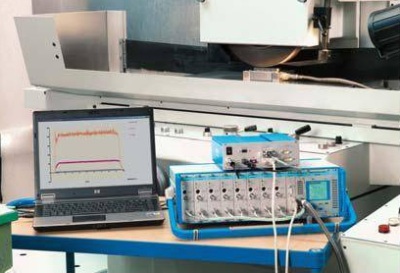
Kistler has developed its new data acquisition (DAQ) system Type 5697A… for recording data in R&D laboratory applications. It is suitable for acquiring and evaluating up to 28 channels at a high sampling rate. The system is supported by data acquisition and evaluation software DynoWare Type 2825A…
The acquisition box, which holds the HASP key (dongle) with runtime license, controls the charge amplifier or signal conditioner directly via RS-232C interface. A USB 2.0 interface makes the system independent of PCI and PCMCIA interfaces. Power is supplied via a robust Binder connector. Measurements can be started remotely via the D-sub connector incorporated in the acquisition box.
The new version of DynoWare is designed primarily for measuring forces with dynamometers or single- or multicomponent sensors. It includes different functions for online visualization, signal evaluation and calculation, individual documentation and saving of configuration and measurement data. It configures and controls all Kistler laboratory charge amplifiers and signal conditioners, now also including single-channel charge amplifier Type 5018A… and multichannel amplifier Type 5080A…
Universal DAQ System Has Eight Individual Analog Voltage Outputs
June 29, 2010 by admin
Filed under Bench Test, data acquisition, Meters & Testers
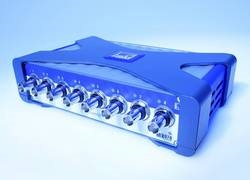
Many test and measurement tasks require measured physical parameters to be output as a standardized voltage. For these applications, HBM released the MX878 output module – a new module of the flexible and powerful QuantumX data acquisition system.
The output module has eight analog voltage outputs that can be individually configured. The module enables system signals to be output as scaled and filtered values in the range of ±10 V. All signals supplied by the amplifiers can be used as signal sources. This makes individual monitoring or forwarding of system signals such as measured values very easy.
In addition, the module offers integrated local intelligence that enables measured values to be analyzed or set off against each other in real time using algebraic operations. The module also features functions for the computation of peak value or root mean square value. Computed signals can be made available in the system in real time or the can be output directly.
The functions or outputs can be configured directly using QuantumX Assistant software, LabView® VIs or the user’s individual programs via the integrated QuantumX programming interface (API) for .NET or COM. catmanAP software provides comprehensive options for configuration, data acquisition, visualization and analysis.
Typical fields of application of the new MX878 QuantumX module include for example test bench applications involving conversion of various transducer signals.
Further information at