• Skip to primary navigation
  • Skip to main content
  • Skip to primary sidebar
  • Skip to footer
  • Advertise
  • Subscribe

Test & Measurement Tips

Oscilloscopes, electronics engineering industry news, how-to EE articles and electronics resources

  • Oscilloscopes
    • Analog Oscilloscope
    • Digital Oscilloscope
    • Handheld Oscilloscope
    • Mixed-signal Oscilloscope
    • PC-based Oscilloscopes – PCO
  • Design
  • Calibration
  • Meters & Testers
  • Test Equipment
  • Learn
    • eBooks/Tech Tips
    • FAQs
    • EE Training Days
    • Learning Center
    • Tech Toolboxes
    • Webinars & Digital Events
  • Video
    • EE Videos
    • Teardown Videos
  • Resources
    • Design Guide Library
    • Digital Issues
    • Engineering Diversity & Inclusion
    • Leap Awards
    • White Papers
  • Subscribe
You are here: Home / Featured / Basics of induction

Basics of induction

March 29, 2016 By David Herres Leave a Comment

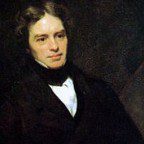
Building on the work of others, particularly Humphry Davy, Hans Christian Ørsted and Alessandro Volta, English researcher Michael Faraday formulated his Law of Electromagnetic Induction. This most basic of all laws governing electromagnetism quantifies the interaction of a magnetic field and an electric circuit, producing electromotive force (EMF) or in the language of technicians and researchers today, voltage.
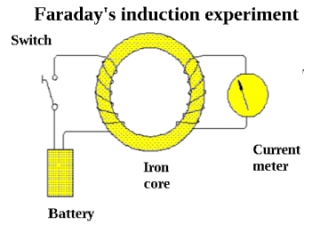
faraday induction experiment setup
In Faraday’s iron ring apparatus, a change in the magnetic flux of the left coil induces a current in the right coil.

Joseph Henry, in America, independently discovered the same phenomenon in 1832, but because Faraday was first to publish his findings, he is generally credited with discovering electromagnetic induction. The law that bears his name may be stated simply: The induced EMF in a closed electrical circuit equals the negative of the rate of change of the magnetic flux enclosed by the circuit. This statement is not universally valid, however, strictly applying only when the electrical circuit is composed of an infinitely thin conductor.
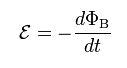
faraday law
Faraday’s law of induction. Here, ε is the electromotive force and ΦB is the magnetic flux.
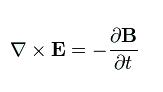
maxwell faraday equation
The Maxwell–Faraday equation generalizes Faraday’s law. Here ∇ is the curl operator, E is the electric field, B is the magnetic field. These fields can generally be functions of position and time.
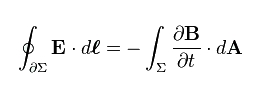
The integral form of the Maxwell-Faraday equation
The integral form of the Maxwell-Faraday equation where Σ is a surface bounded by the closed contour ∂Σ, dℓ is an infinitesimal vector element of the contour ∂Σ, dA is an infinitesimal vector element of surface Σ.

James Clerk Maxwell in 1861 amended, generalized and incorporated Faraday’s Law of Induction into Maxwell’s Third Equation of Electromagnetism, which states that a time-varying magnetic field is always accompanied by a spatially-varying non-conservative electric field (generator) and a time-varying electric field is always accompanied by a spatial-varying non-conservative magnetic field (electric motor).

Faraday was a deeply religious man with a strong sense of ethics. He came from a family that was not wealthy, and he received a minimal formal education. In his class-conscious social environment, he had to struggle to secure a living. Eventually his diligence and powerful intellect were widely recognized and he received many honors. Late in life he was approached by the British government to assist in the production of chemical weapons to be used in the Crimean War. Faraday declined this proposition on ethical grounds.

You may also like:

  • faraday himself
    Faraday and his law of induction

Filed Under: FAQ, Featured, New Articles Tagged With: FAQ

Reader Interactions

Leave a Reply Cancel reply

You must be logged in to post a comment.

Primary Sidebar

Featured Contributions

Why engineers need IC ESD and TLP data

Verify, test, and troubleshoot 5G Wi-Fi FWA gateways

How to build and manage a top-notch test team

How to use remote sensing for DC programmable power supplies

The factors of accurate measurements

More Featured Contributions

EE TECH TOOLBOX

“ee
Tech Toolbox: Power Electronics
Our latest eBook compiles essential technical articles covering freewheeling diodes, snubber circuits, coreless transformers in solid-state isolators, PWM current source converters, hot-swap implementation, inrush current analysis, and inverter switching strategies for battery longevity.

EE TRAINING CENTER

EE Learning Center
“test
EXPAND YOUR KNOWLEDGE AND STAY CONNECTED
Get the latest info on technologies, tools and strategies for EE professionals.
bills blog

RSS Current Electro-Tech-Online.com Discussions

  • MCS-51 Development Ecosystem
  • ESP32 Sub Forum
  • Please could you advise me on this circuit for car OBD2
  • Mitsubishi projection lamp
  • What branch of electronics has easy spare parts sourcing in north africa ?

Footer

EE World Online Network

  • 5G Technology World
  • EE World Online
  • Engineers Garage
  • Analog IC Tips
  • Battery Power Tips
  • Connector Tips
  • EDA Board Forums
  • Electro Tech Online Forums
  • EV Engineering
  • Microcontroller Tips
  • Power Electronic Tips
  • Sensor Tips

Test & Measurement Tips

  • Subscribe to our newsletter
  • Advertise with us
  • Contact us
  • About us

Copyright © 2026 · WTWH Media LLC and its licensors. All rights reserved.
The material on this site may not be reproduced, distributed, transmitted, cached or otherwise used, except with the prior written permission of WTWH Media.

Privacy Policy