Gain as a parameter is frequently used with reference to an amplifier, although other contexts are possible. It is the ratio of output amplitude or power of the output to the same value at the input. So that the number does not become unwieldy, a logarithmic decibel scale is ordinarily used. For an audio amplifier, this works well because it corresponds to the way in which human hearing perceives the volume of sound.
When this ratio is greater than one, defined as zero on the decibel scale, the signal is being amplified. When it is less than one, the signal is being attenuated.
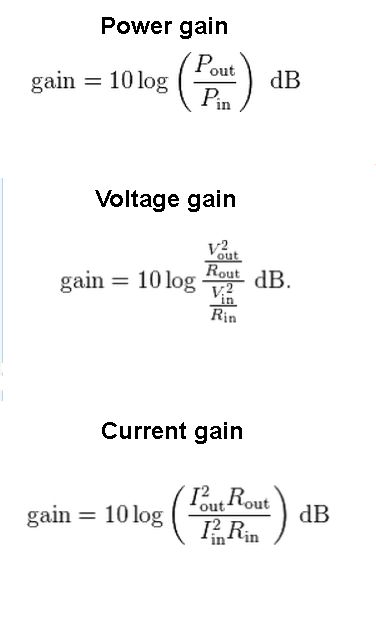 The ratio known as gain can refer to voltage, as in an op amp, current, or power (in decibels) used in radio frequency (RF) amplifiers. Gain applies to an active device whether it is in an energized circuit or on the shelf in a warehouse. However, it varies to a greater or lesser degree depending upon the frequency of the signal.
Gain is a significant parameter for any transistor that is not in a saturation mode. In transistors what is referred to is ratio of the current at the output terminals to current or voltage at the input terminals. (In a three-wire device, one terminal is common).
In the common-emitter configuration, βF (or in h-parameter notation hFEE) is the current gain. For small-signal transistors it is generally higher than 50, but of course this is an impossibility in high-power devices where the gain is usually slightly less than one.
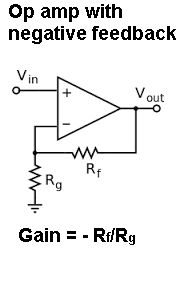 An op amp in a closed-loop configuration is one where the output connects to an inverting input. This is possible in the op amp because it is one type of differential amplifier where the two inputs are 180° out of phase.
Too much gain is not a good thing. A case in point is the op amp. Its gain can be 10,000 to over 100,000. Even a tiny input can render the device and circuit useless. A solution is to connect the output through a resistor, Rf, to an inverting input, which is fed through another resistor, Rg. This greatly reduces the gain and makes for a stable configuration.

Leave a Reply
You must be logged in to post a comment.