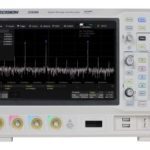
The 2560B Digital Storage (DSO) and Mixed Signal Oscilloscope (MSO) Series offers 100 MHz, 200 MHz and 350 MHz bandwidth models in a four-channel configuration, with a sample rate of 2 GSa/sec and a maximum memory depth of 200 Mpts. Additionally, these oscilloscopes are equipped with a large 10.1-in capacitive touch display that provide 1,024 […]
Digital Oscilloscope
Odd ball application department: Using a scope to display SEM images
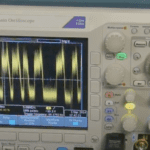
The Applied Science YouTube channel run by Ben Krasnow (who in his day job is a hardware engineer at Verily, Google Life Sciences) focuses on interesting applications of science and technology. One video in particular caught our eye where Kranow uses an oscilloscope to help view digital images captured by a scanning electron microscope made […]
Sampling oscilloscope upgraded with PAM4 evaluation functions
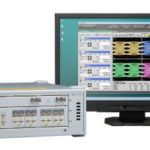
Tghe Signal Processing Software Option-098 adds upgraded functions for evaluating PAM4 differential electrical signals to the Anritsu BERTWave Sampling Oscilloscope MP2110A. This new option supports standards-compliant measurement of IEEE 802.3 optical-module electrical interfaces to facilitate faster communications at data centers and mobile networks by upgrading evaluation efficiency for 50 to 400G optical modules using PAM4 […]
Scopes feature 5.6-in full HD touchscreen, 1 million wf/sec update rate
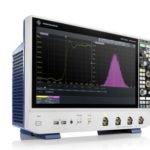
The new R&S RTO6 digital oscilloscope offers six different bandwidth models from 600 MHz to 6 GHz and a sample rate of up to 20 Gsample/sec. The fully integrated test solution for the time and frequency domain, as well as protocol and logic analysis, supports design engineers from all industries. The instrument features a high waveform update rate, excellent […]
New scopes sport 12-bit resolution, 15.6-in displays, include waveform generation/spectrum analysis

The HDO6000B Series brings together high sample rate 12-bit ADCs, high signal-to-noise amplifiers and low-noise system architecture. Oscilloscopes with HD4096 technology always provide 12 bits of vertical resolution. “No digitizer is perfect,” says Robert Mart, Teledyne LeCroy’s Director of Product Marketing, “but compared to an 8-bit system, a 12-bit system is 16 times closer to […]
Rack-mount scope targets high throughput, high channel count apps
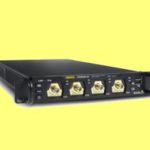
The DS8000-R rack-mount digital oscilloscope provides up to 2 GHz bandwidth and the same jitter and real-time eye analysis, power analysis, and serial decode as RIGOL’s proven MSO8000 Series oscilloscope. The space-saving DS8000-R oscilloscope is designed for instrument synchronization for small to large system configurations. Featuring a typical trigger jitter between instruments of less than […]
Basics of digital oscilloscope architecture
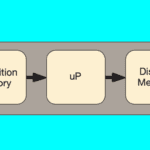
A digital storage oscilloscope (DSO) is characterized by the presence of a microprocessor, which is physically and functionally at the heart of the processing section. Other stages in the processor are the acquisition memory, at its input and the display memory at its output. The DSO’s signal paths (one for each channel) begin at the […]
PC-based scopes provide up to eight 12-bit channels
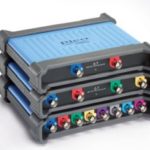
The PicoScope PS4000A Series of 20-MHz USB 3.0-connected PC oscilloscopes provide two, four, or eight high-resolution analog channels. These portable scopes have a compact footprint with BNC connectors that accept all common probes and accessories. With a high vertical resolution of 12 bits, 20-MHz bandwidth, 256-MSa buffer memory, and a fast sampling rate of 80 […]
Economical 4-channel 100-MHz scope features advanced triggering, deep memory
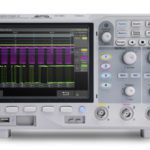
The SDS1104X-U four-channel 100-MHz oscilloscope is a lower priced, economy version of the very popular SDS1104X-E. Many excellent features have been retained, including the large 7-in TFT-LCD display and ergonomic front panel design, while economies have been made by removing the optional MSO and function generator upgrade capabilities, a reduced time-base resolution and vertical resolution, […]
Software enables remote viewing, analysis of data from multiple scopes simultaneously

TekScope PC Software with enhanced Multi-Scope Analysis allows remote users to view and analyze data from up to 32 channels from multiple scopes at the same time in the same interface, accelerating analysis efficiency. The Multi-Scope Analysis feature enables uses to remotely control the acquisition settings on all scopes simultaneously without the need to set […]