Gravitational waves were first proposed by Henri Poincaré in 1905 and further described in Albert Einstein’s 1916 General Theory of Relativity. Gravitational Waves are powerful perturbations of the space-time continuum. However, the sources of gravitational waves we know about are enormously distant and therefore faint by the time they reach earth–like EM radiation, their intensity falls off at a 1/r2 rate. And like EM waves, they travel at the speed of light.
Gravitational waves arise when massive gravitational systems rotate about a common point or when they collide. Such systems include white dwarf and neutron stars, black holes, supernovae and the primordial Big Bang.
The Laser Interferometer Gravitational-Wave Observatory (LIGO) is designed to detect cosmic gravitational waves. It consists of two large observatories sitting in Hanford, Wash. and Livingston, La. Measurements made at the two sites are independent; Because of the fantastically small perturbations in space that arise from gravity waves, measurements made at one site serve as a sanity check for those at the other.
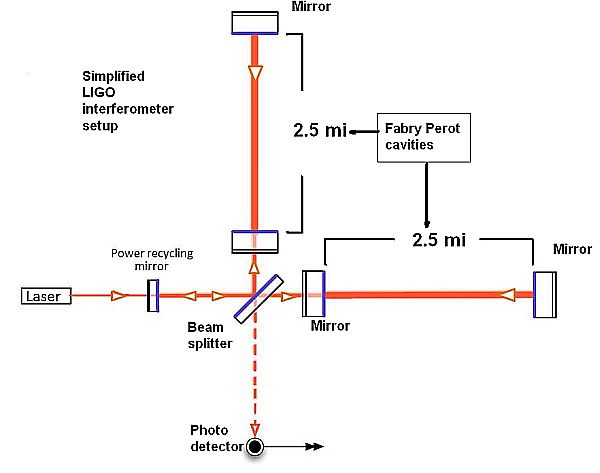
For detection purposes, LIGO researchers use the fact that a gravity wave expands space in one direction and simultaneously compresses it in the direction 90° away. To say the expansion and compression is tiny would be an understatement. Scientists say the effect is less than 1/1,000 of the diameter of a proton over the distances measured by the LIGO facilities.
To make measurements, LIGO uses a laser interferometer with two legs spaced 90° apart. The arms are 2.5 mi. long, making the LIGO interferometer by far the largest ever built.
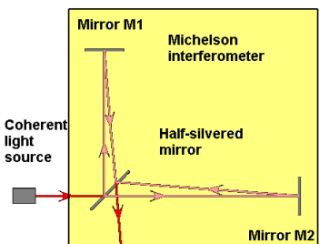
As a quick review, interferometers work by merging two or more sources of light to create an interference pattern. The basic configuration consists of a laser, a beam splitter, a series of mirrors, and a photodetector. If the beams travel exactly the same distance down the two arms, their light waves will be perfectly aligned. The result is total destructive interference at the photodetector, i.e. no light, if no gravitational waves are passing. But if for some reason the laser beams don’t travel the same distances, their light waves go out of sync as they merge, allowing some amount of laser light to reach the photodetector.
Though the LIGO interferometer arms are about 2.5 mi long, that’s still too short to detect gravitational waves. So the device includes Fabry Perot cavities in which an additional mirror sits in each arm near the beam splitter, about 2.5 mi from the mirror at the end of that arm. After entering the instrument via the beam splitter, the laser in each arm bounces between its two mirrors about 300 times before merging with the beam from the other arm. These reflections both build up the laser light within the interferometer, increasing sensitivity, and increase the distance traveled by each laser from 2.5 mi to more than 745 mi.
Unfortunately, with arms effectively that long, LIGO interferometers can also amplify any miniscule vibrations. Hence the need for the sanity check of a second interferometer.
LIGO interferometers also incorporate measures aimed at allowing use of lasers with a power output lower than what would otherwise be necessary. LIGO’s laser first enters the interferometer at about 40 W, but the device needs about 750 kW to register interference patterns via the super-long interferometer arms. Power recycling mirrors provide the required boost. Inside the interferometer, light from the laser passes through the transparent side of a power recycling mirror to the beam splitter and then on to the arms of the interferometer. As laser light enters the interferometer, the power recycling mirror continually reflects that which has traveled through the instrument back into the interferometer (hence recycling it).
The boost in power from power recycling sharpens the interference fringes that appear when the two beams are superimposed–fringes that indicate a gravitational wave has passed. The interferometers also contain signal recycling mirrors, which, like power recycling, enhance the signal received by the photodetector.
The LIGO installations are constantly upgraded. One improvement anticipated for 2027 will double sensitivity and reduce the low-frequency detection cutoff to 10 Hz. Operating temperature will be 123°K.
A point to note is that laser interferometers aren’t the only measurement devices designed to detect gravitational waves. The Weber bar, for example, was a solid metal bar set up so passing gravitational waves would cause the bar to oscillate at its resonant frequency. The vibrations could then be amplified so as to detect gravitational waves. The inventor, Joseph Weber, reported positive results, but others contested his findings. A more recent model, cryogenically-cooled and equipped with superconducting quantum interference devices, is reported to have detected the most powerful gravitational waves.
MiniGRAIL uses the same principle. It consists of a precisely-machined 1,150-kg sphere cooled to close to 0°K. Because the sphere is equally sensitive in all directions, gravitational waves produce measurable deformations of the ideal spherical form. The device is particularly sensitive to gravitational waves ranging from two to four kilohertz. It has detected gravitational waves from a slightly aspherical (mirror-smooth except for a four-inch mountain) rotating neutron star and merging black holes.
At the high-frequency end of the gravitational wave spectrum (10-7 to 105 Hz), two detectors are operational. At the University of Birmingham, England, a detector measures changes in the polarization of a microwave beam circulating in a one-meter closed loop. In Genoa, Italy, a resonant antenna consists of two coupled spherical superconducting oscillators. A third detector at Chongqing University, China, is currently under development that will detect high-frequency gravitational waves in excess of 100 GHz. (Those gravitational waves passing through your living room are oscillating 100 billion cycles per second!)
However, the most sensitive gravitational wave detectors are interferometer-based instruments. Besides their sensitivity to environmental vibrations. they are prone to shot-noise interference at high frequencies because lasers produce photons at random intervals. Additionally, operated at high power, the laser photons cause mechanical motion of the mirrors, which disrupt high-frequency performance. These defects, however, may be corrected prior to detection. Generally, the interferometer-based gravitational wave detector has the potential for providing best results.
Amateurs figure prominently in gravitational wave computation. Einstein@Home is a distributed computing project analogous to Seti@Home. It distributes data from LIGO and GEO to thousands of volunteers for analysis on their home computers. To participate in the cross-platform project, go to Einsteinathome.org.


Leave a Reply
You must be logged in to post a comment.