• Skip to primary navigation
  • Skip to main content
  • Skip to primary sidebar
  • Skip to footer
  • Advertise
  • Subscribe

Test & Measurement Tips

Oscilloscopes, electronics engineering industry news, how-to EE articles and electronics resources

  • Oscilloscopes
    • Analog Oscilloscope
    • Digital Oscilloscope
    • Handheld Oscilloscope
    • Mixed-signal Oscilloscope
    • PC-based Oscilloscopes – PCO
  • Design
  • Calibration
  • Meters & Testers
  • Test Equipment
  • Learn
    • eBooks/Tech Tips
    • FAQs
    • EE Training Days
    • Learning Center
    • Tech Toolboxes
    • Webinars & Digital Events
  • Video
    • EE Videos
    • Teardown Videos
  • Resources
    • Design Guide Library
    • Digital Issues
    • Engineering Diversity & Inclusion
    • Leap Awards
    • White Papers
  • Subscribe
You are here: Home / Sensing / Instrumentation / Expanded Bandwidth Options on Arbitrary Waveform Generator

Expanded Bandwidth Options on Arbitrary Waveform Generator

February 27, 2012 By Test and Measurement Editor Leave a Comment

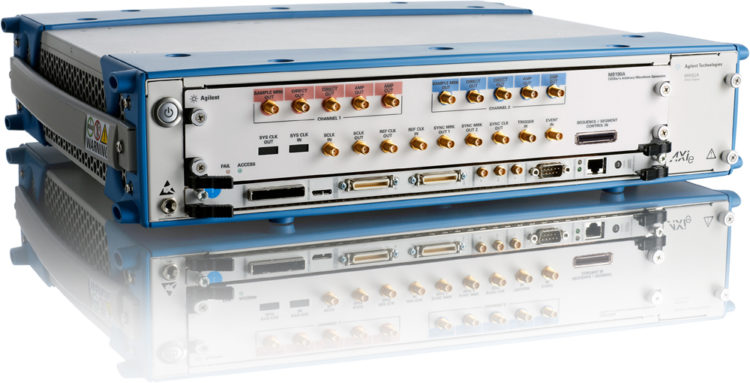
Agilent Technologies Inc. (NYSE: A) announced enhancements to its industry-leading, high-resolution, wide-bandwidth M8190A arbitrary waveform generator. The enhancements allow engineers to create signal scenarios using the 5- to 7-GHz spectrum.

The Agilent M8190A is a source of high fidelity because it simultaneously delivers wide bandwidth and high resolution with up to 80 dBc of spurious-free dynamic range. This unique combination lets engineers create signal scenarios that push their designs to the limit and bring new insights to their analyses.

An AWG is the most versatile signal scenario generator possible. Capabilities such as easy switching between 14-bit output at 8 GSa/s and 12-bit output at 12 GSa/s help engineers handle multiple applications and measurement requirements.

The device contains three amplifiers that are optimized for different applications. The latest enhancements take the instrument’s versatility one step further with support for various output formats, including NRZ (no return to zero), DNRZ (double no return to zero), RZ (return to zero) and doublet mode.

Engineers working on applications that require the highest spurious-free dynamic range can use the DNRZ format. For time-domain applications requiring the best pulse performance, engineers can use the NRZ format. If they need a higher frequency spectrum, they can switch into doublet mode, which allows them to use the 5- to 7-GHz spectrum. Engineers working on RF applications can select between the desired frequency spectrums.

Agilent Technologies Inc.
www.agilent.com

 

Filed Under: Instrumentation, New Articles Tagged With: Agilent, arbitrary waveform generator, high frequency

Reader Interactions

Leave a Reply Cancel reply

You must be logged in to post a comment.

Primary Sidebar

Featured Contributions

Why engineers need IC ESD and TLP data

Verify, test, and troubleshoot 5G Wi-Fi FWA gateways

How to build and manage a top-notch test team

How to use remote sensing for DC programmable power supplies

The factors of accurate measurements

More Featured Contributions

EE TECH TOOLBOX

“ee
Tech Toolbox: Connectivity
AI and high-performance computing demand interconnects that can handle massive data throughput without bottlenecks. This Tech Toolbox explores the connector technologies enabling ML systems, from high-speed board-to-board and PCIe interfaces to in-package optical interconnects and twin-axial assemblies.

EE TRAINING CENTER

EE Learning Center
“test
EXPAND YOUR KNOWLEDGE AND STAY CONNECTED
Get the latest info on technologies, tools and strategies for EE professionals.
bills blog

RSS Current Electro-Tech-Online.com Discussions

  • My Advanced Realistic Humanoid Robots Project
  • Wien bridge oscillator
  • Variable audio oscillator
  • Micro mouse
  • Silicone insulated wire

Footer

EE World Online Network

  • 5G Technology World
  • EE World Online
  • Engineers Garage
  • Analog IC Tips
  • Battery Power Tips
  • Connector Tips
  • EDA Board Forums
  • Electro Tech Online Forums
  • EV Engineering
  • Microcontroller Tips
  • Power Electronic Tips
  • Sensor Tips

Test & Measurement Tips

  • Subscribe to our newsletter
  • Advertise with us
  • Contact us
  • About us

Copyright © 2026 · WTWH Media LLC and its licensors. All rights reserved.
The material on this site may not be reproduced, distributed, transmitted, cached or otherwise used, except with the prior written permission of WTWH Media.

Privacy Policy