• Skip to primary navigation
  • Skip to main content
  • Skip to primary sidebar
  • Skip to footer
  • Advertise
  • Subscribe

Test & Measurement Tips

Oscilloscopes, electronics engineering industry news, how-to EE articles and electronics resources

  • Oscilloscopes
    • Analog Oscilloscope
    • Digital Oscilloscope
    • Handheld Oscilloscope
    • Mixed-signal Oscilloscope
    • PC-based Oscilloscopes – PCO
  • Design
  • Calibration
  • Meters & Testers
  • Test Equipment
  • Learn
    • eBooks/Tech Tips
    • FAQs
    • EE Training Days
    • Learning Center
    • Tech Toolboxes
    • Webinars & Digital Events
  • Video
    • EE Videos
    • Teardown Videos
  • Resources
    • Design Guide Library
    • Digital Issues
    • Engineering Diversity & Inclusion
    • Leap Awards
    • White Papers
  • Subscribe
You are here: Home / Oscilloscopes / Digital Oscilloscope / GW Instek GDS-3252 Digital Oscilloscope

GW Instek GDS-3252 Digital Oscilloscope

November 10, 2011 By Test and Measurement Editor Leave a Comment

GW Instek (www.gwinstek.com) has introduced a dual channel oscilloscope from its GDS-3000 Series that offers 250 MHz bandwidth, a rise time of 1.4 ns, a maximum sample rate of 2.5 GSa/s and an equivalent time sample rate of up to 100 GSa/s.

The GDS-3252 features a unique split screen that allows users to operate each channel independently with respective waveform and setting display. The vertical sensitivity, time base and trigger selections can be performed separately by each channel, while the waveform of each channel signal can be displayed on the screen’s individual part. This feature is especially useful for applications that require simultaneous viewing of details of multiple waveforms with varying characteristics.

Aside from two new current probes, the digital oscilloscope package also comes with three new differential probes, GDP-100, GDP-050 and GDP-025, offering total solutions for various applications in the industry, education and service market sectors.
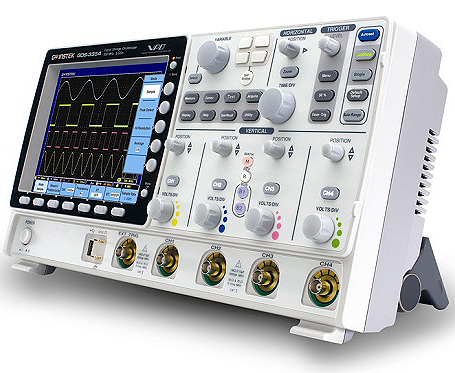
GDS-3252-Oscilloscope

The oscilloscope’s auto range function automatically adjusts the displayed waveform’s vertical scale and/or the time base when the amplitude and/or the frequency of the input signal change.

The GDS-3252’s various trigger functions include edge, pulse width, video, rise time and fall time, runt, delay by time, alternate, hold-off and delay by event. Its high sampling rate, flexible trigger function and VPO signal processing and display all contribute to make the oscilloscope a powerful device for capturing waveforms and displaying various types of signals.

Filed Under: Digital Oscilloscope, Oscilloscopes Tagged With: digital oscilloscope, GW instek

Reader Interactions

Leave a Reply Cancel reply

You must be logged in to post a comment.

Primary Sidebar

Featured Contributions

Why engineers need IC ESD and TLP data

Verify, test, and troubleshoot 5G Wi-Fi FWA gateways

How to build and manage a top-notch test team

How to use remote sensing for DC programmable power supplies

The factors of accurate measurements

More Featured Contributions

EE TECH TOOLBOX

“ee
Tech Toolbox: Connectivity
AI and high-performance computing demand interconnects that can handle massive data throughput without bottlenecks. This Tech Toolbox explores the connector technologies enabling ML systems, from high-speed board-to-board and PCIe interfaces to in-package optical interconnects and twin-axial assemblies.

EE TRAINING CENTER

EE Learning Center
“test
EXPAND YOUR KNOWLEDGE AND STAY CONNECTED
Get the latest info on technologies, tools and strategies for EE professionals.
bills blog

RSS Current Electro-Tech-Online.com Discussions

  • BPF
  • wall transformer polarity
  • Do i need a buffer?
  • Figgie International intercom 1998 era
  • FM Radio circuits

Footer

EE World Online Network

  • 5G Technology World
  • EE World Online
  • Engineers Garage
  • Analog IC Tips
  • Battery Power Tips
  • Connector Tips
  • EDA Board Forums
  • Electro Tech Online Forums
  • EV Engineering
  • Microcontroller Tips
  • Power Electronic Tips
  • Sensor Tips

Test & Measurement Tips

  • Subscribe to our newsletter
  • Advertise with us
  • Contact us
  • About us

Copyright © 2026 · WTWH Media LLC and its licensors. All rights reserved.
The material on this site may not be reproduced, distributed, transmitted, cached or otherwise used, except with the prior written permission of WTWH Media.

Privacy Policy