The Lab Brick® family of USB-compatible signal generators cover frequencies from 50 MHz to 6 GHz in a fraction of the cost and size of traditional test signal sources.
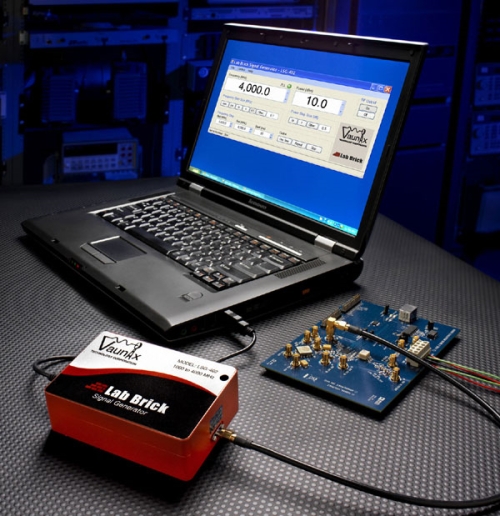 Signal generators are essential to most test systems, but they are typically too large and expensive for portable measurement applications. In cases where portability is important, the Lab Brick® family of signal generators from Vaunix Technology Corporation includes five low-cost, compact models covering a total range of 50 MHz to 6 GHz with high output levels and excellent spectral purity. They can be powered and controlled by means of a Universal Serial Bus (USB) equipped personal computer (PC) or laptop computer, or operate under battery power or with a remote power supply for embedded or automated applications.
The five members of the Lab Brick® signal generator family are models LSG-251 (50 to 250 MHz), LSG-152 (250 to 1500 MHz), LSG-222 (500 to 2200 MHz), LSG-402 (1000 to 4000 MHz), and LSG-602 (1500 to 6000 MHz). Each Lab Brick® signal generator (Fig. 1) measures 4.90 x 3.14 x 1.59 in. (124 x 80 x 40 mm) and weigh less than 1 lb. (0.45 kg). It can be connected to a host computer by means of a standard USB cable and controlled by means of Graphical User Interface (GUI) software run on the host computer. The simple GUI features large display windows to quickly view and adjust the signal generator’s frequency and amplitude.
The Lab Brick® signal generators each deliver at least +10 dBm output power across their full operating-frequency ranges. Signals are available at an SMA connector, and output levels can be adjusted via the GUI software over a control range of 50 dB (-40 to +10 dBm) for the 6-GHz model LSG-602 and 55 dB (-45 to +10 dBm) for the other four models. Output-level settings are accurate within +1.5 dB and -0.5 dB. In addition to controlling output levels, the GUI allows an operator to complete shut off the signal generator’s output power. Frequency can be set with 100-kHz resolution, with initial accuracy (before aging) of better than ±2 PPM.
In spite of being low-cost, portable units, these high-performance signal generators boast low phase noise and excellent spectral purity. For the 250-to-1500-MHz model LSG-152, for example, the single-sideband (SSB) phase noise is typically -95 dBc/Hz offset 10 kHz from the carrier and -115 dBc/Hz offset 100 kHz for the carrier (Fig. 2). For the 50-to-250-MHz model LSG-251, the phase noise is typically -105 dBc/Hz offset 10 kHz from the carrier and -125 dBc/Hz offset 100 kHz from the carrier. For the 1000-to-4000-MHz model LSG-402, the phase noise is typically -85 and -105 dBc/Hz, respectively, at 10- and 100-kHz offsets, while for the 1500-to-6000-MHz model LSG-602, the phase noise is typically -75 and -95 dBc/Hz, respectively, at 10- and 100-kHz offset frequencies. For all models, harmonics are typically -10 dBc while spurious content is typically -80 dBc.
The Lab Brick® signal generators include a green LED status indicator to show connection to a USB host computer. When the host computer recognizes a Lab Brick® signal generator, it loads the GUI software and displays that signal generator’s serial number and model number. The GUI software can track and control several connected Lab Brick® signal generators, simplifying multiple-signal test setups. In addition, each Lab Brick® signal generator can store settings in internal memory, allowing it to power up in a specific instrument state. This same capability also allows a Lab Brick signal generator to be used in an embedded or remote instrument application without USB control required to achieve a given instrument state. In non-USB applications, the Lab Brick® signal generators can operate with battery power or remote power supply. For automatic-test-equipment (ATE) applications, a programming guide is available for each Lab Brick® signal generator. In addition, they are programmable by means of LabView software drivers from National Instruments (www.ni.com).
A Lab Brick® signal generator provides several operating modes, including continuous-wave (CW) and swept-frequency operation. In CW mode, the sources deliver a fixed-frequency, sinusoidal output signal. In the swept-frequency mode, the generators can perform a single sweep or continuous sweeps across a user-defined frequency band in user-defined frequency steps. A user can define not only the frequency step size but the frequency dwell time.
The RoHS-compliant signal generators are supplied in rugged aluminum housings complete with mounting holes. Lab Brick® signal generators comply with international requirements for electromagnetic-compatibility (EMC) emissions and immunity for Class A ISM devices to ensure that they don’t interfere with other ISM-band equipment. Each Lab Brick® signal generator is shipped with a 6-ft.-long USB cable and a USB flash memory drive containing the GUI software and a software file copy of the user manual. Lab Brick® signal generators can be used with any PC or laptop computer with USB 2.0 port (or powered USB hub) and running the Windows 2000, XP, or Vista operating system.

Leave a Reply
You must be logged in to post a comment.