The hybridNETBOX instrumentation platform covers applications that require simultaneous signal generation and acquisition. Six models are available offering the choice of two, four or eight pairs of matched AWG and digitizer channels, with output- and sampling-rates of 40, 80 and 125 Megasamples/sec. Prices start from $12,930. With their ability to create and acquire electronic signals at the same time, these products are candidates for measurement systems that need to perform automated closed-loop or stimulus-response type testing. For example, they can reproduce and capture “echo” signals such as those found in Radar, Sonar, Lidar or Ultrasound. With their multi-channel capability, they can test these systems even when arrays of transmitters and receivers are used.
The hybridNETBOX is also suited to ATE applications where components and subassemblies must be tested in a 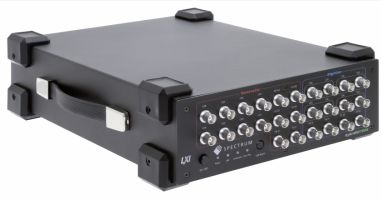 fast and automated way. They can quickly ascertain the functionality and tolerance of DUTs and UUTs (devices or units under test) by exercising them with numerous, easily adjusted, complex signals. This powerful testing process can be deployed in a host of applications like Bus testing, MIMO communications, circuit verification, mechatronics and robotics.
For accurate, low-noise waveform generation and acquisition, the units all use the latest 16-bit digital-to-analog, and analog-to-digital, converter technology. All the channels are synchronized, sharing a common clock and trigger. The AWG channels can produce almost any waveform with signal amplitudes that go up to ±6 V into 50 Ω, or ±12 V into high impedance. Waveform output modes include Single-Shot, Loop, FIFO Streaming, Gated Replay and Sequence Replay. This permits the easy creation of test routines that can go from simple to complex. Meanwhile, the digitizer channels are designed to handle a wide range of input signals. They have variable input ranges that go from ±200 mV up to ±10 V, with fully programmable offset and selectable input impedance (50 Ω and 1 MΩ). Both single-ended and differential measurement modes are available. Like the AWG channels, they support a number of operating modes including Single-Shot, FIFO Streaming, Multiple Recording, Gated Sampling, and ABA (sample rate switching). This combines with a variety of flexible trigger modes (Channel, External, Software, Window, Pulse, Re-Arm, Spike, Logic and Delay) to make sure that an important event is never missed.
In addition to the digitizer and AWG channels, the front-panel of each hybridNETBOX includes multiple digital I/O connectors. These make it easy to integrate units into a test system. For example, synchronous marker outputs are available that can be used on the AWG channels to allow precise control of other devices or instruments. Similarly, it’s possible to synchronize the unit with other equipment, by applying an external clock and triggers.
As the hybridNETBOX instruments are fully LXI compliant, they’re easy to control and operate. Just connect the unit to a PC or a company network via the rear panel Gbit Ethernet port. The instruments come with all the tools needed to start generating waveforms and acquiring signals. Each hybridNETBOX includes Spectrum’s own control software — SBench 6 — for signal generation, acquisition, display, signal processing, storage and reporting. SBench 6 allows waveforms to be created using standard functions and mathematical equations.
Data can be acquired with the digitizer part and then being transferred to the AWG for replay. Data sharing with other programs or devices, such as oscilloscopes, is possible using built in import/export functions for transferring data in Binary, ASCII or Wave formats. Fully programmable, the hybridNETBOX comes with drivers for Windows and Linux operating systems, as well as programming examples for C++, LabVIEW, MATLAB, Visual Basic .NET, Python and other popular programming languages.
Spectrum Instrumentation Corp., USA, (201) 562-1999, Sales@spectrum-instrumentation.com, https://spectrum-instrumentation.com/sites/default/files/hybrid-app.pdf

Leave a Reply
You must be logged in to post a comment.