Two new PCIe Digitizer cards from Spectrum Instrumentation bring next-generation performance to PC-based instrumentation. Using 16-lane, Gen 3, PCIe technology, the cards are capable of streaming acquired data over the bus at a staggering 12.8 GB/sec. That is nearly twice as fast as any other PCIe Digitizer currently on the market. Furthermore, it allows the cards to continuously run at their maximum sampling rate of 6.4 GS/sec, with 12-bit resolution, and transfer the acquired data directly to PC memory for 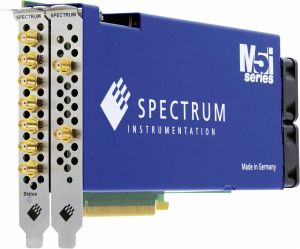 storage, or even to CPUs and CUDA-based GPUs for processing and analysis.
The new products include the model M5i.3330-x16, a single-channel card that can sample at rates up to 6.4 GS/sec, and the M5i.3337-x16, a dual-channel card that offers synchronous 3.2 GS/sec sampling on both channels, or the full 6.4 GS/sec on a single channel. With 12-bit resolution, these fast digitizers offer exceptional dynamic range. It is up to sixteen times better than most digital oscilloscopes or comparable eight-bit digitizers. The extra resolution improves voltage measurement precision and allows users to capture and characterize fine signal details that are often missed by lower resolution devices. Timing measurements are also exceptional thanks to a PLL-based internal clock that has better than 1 ppm accuracy.
Designed to handle a wide variety of signals, the cards feature fully functional front-end electronics with over 2-GHz bandwidth, programmable full-scale ranges from ±200 mV to ±2.5 V and variable offset. Large on-board memories make the capture of long and complex waveforms easy. A generous 4 GB (2 GSamples) of memory is provided as standard and can be optioned up to a massive 16 GB (8 GSamples) if necessary. Single-shot and multiple-waveform recording modes are supported, together with trigger time stamping. Multiple recording divides the on-board memory into segments and allows the acquisition of numerous events, even at high trigger rates. It is perfect for situations like those encountered in serial bus testing, or in systems using stimulus-response processes, such as those found in LIDAR and RADAR systems. For added flexibility, the on-board memory can be used as a ring-buffer, working much like a conventional oscilloscope, or as a FIFO-buffer, for the continuous streaming of data to the PC environment.
Integration into almost any test system is simple as the front panel boasts SMA connectors for the channel inputs, clock and trigger inputs and outputs, as well as four multi-functional digital I/O lines. The extra clock and trigger connections make it possible to synchronize the cards with additional digitizers or other measurement devices.
To verify the transfer speed of the new digitizers, the company ran the products in a variety of different PC platforms. The maximum transfer speeds were obtained using an AMD EPYC Model 7252 server processor. The company also tested, at full speed, direct RDMA data transfers from the digitizer cards to an Nvidia model P2000 GPU. The capability to stream data directly to a CUDA GPU with up to 5,000 processing cores is possible using the company’s SCAPP (Spectrum’s CUDA Access for Parallel Processing) package, which is available as a low-cost option. SCAPP includes the necessary drivers for CUDA GPU support and allows users to develop their own processing routines. Working examples are also included for common functions like continuous averaging for noise reduction or FFTs for spectral analysis.
Installed in a PC, running a Windows or Linux operating system, the cards can be programmed using almost any popular language. This includes C, C++, C#, Delphi, VB.NET, J#, Python, Julia, Java, LabVIEW, and MATLAB. Each card comes with a software development kit that contains all the necessary driver libraries and programming examples. Alternatively, if customers don’t want to write their own code, the company has SBench 6. This powerful GUI provides full card control, along with a host of data display, analysis, storage, and documentation capabilities.
Spectrum Instrumentation Corp., USA, 15 Warren St. Ste 25, Hackensack, NJ 07601, (201) 562-1999, Email: Sales@spectrum-instrumentation.com, spectrum-instrumentation.com/



Leave a Reply
You must be logged in to post a comment.