A new line of Arbitrary Waveform Generators (AWGs) is based on the LXI instrumentation standard and has been created for engineers and scientists that need to simultaneously generate up to 16 precise electronic signals. Small and compact, the units are candidates for automated testing or remote-control type applications.
With six new instruments being released, users are offered a wide choice of 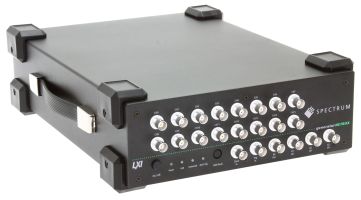 configurations and performance levels. All the units feature the latest 16-bit digital-to-analog converter (DAC) technology and combine this with low-noise flexible outputs; allowing them to generate almost any test signal in the dc to 60-MHz frequency range. Furthermore, full remote control is achieved through a simple Ethernet connection to any PC or local area network (LAN) making them easy to integrate into virtually every test system.
The new DN2.65x series of generatorNETBOX instruments are available with 4, 8 or 16 fully synchronous channels and offer output rates of 40 MS/sec or 125 MS/sec. Signals with a programmable output swing of up to ±6 V into high impedance or ±3 V into 50 Ω can be generated. The units also include large on-board memories of up to 2 x 512 MSamples that can be utilized in a number of different operating modes to allow the generation of long and complex waveforms. This includes Single-Shot, Loop, FIFO, Gated and Sequence Replay modes. Signals can even be generated while new waveform data is being loaded to the on-board memory.
For perfect waveform generation, each channel of the AWG is clocked using a phase-locked loop (PLL) control system that can be generated internally or from an external clock or reference. Four different filters are available to optimize the output signal quality and help ensure excellent dynamic performance. For example, Noise Spectral Density (NSD) is as low as -142 dBm/Hz, Total Harmonic Distortion (THD) is down to -74 dB, Signal to Noise Ratio (SNR) is as high as 90 dB and Spurious Free Dynamic Range (SFDR) is up to 97 dB. It’s a total performance level that allows users to generate the highest quality test signals.
The AWG’s flexibility is further enhanced by front-panel multi-purpose I/O connectors that allow access to synchronous digital (marker) outputs, trigger output, run and arm status, the PLL reference clock or asynchronous I/O lines.
Weighing as little as 6.3 kg, the generatorNETBOX products are easily portable and can work almost anywhere: freestanding on a test bench, rack-mounted with other equipment or even mobile (when powered by the optional 12 or 24 Vdc sources).
The instruments are fully self-contained and come with all the tools necessary to generate an unlimited variety of waveforms. Simply connect them to a host computer (e.g. laptop or workstation) or anywhere on the corporate network and start-up Spectrum’s SBench 6 Professional software. SBench 6 comes as standard with every unit. It lets you control all the operating modes and hardware settings from a simple, easy-to-use, graphical user interface. The software also has a host of built-in features for waveform creation, data analysis and documentation. These include the EasyGenerator function for producing standard wave shapes such as sine, rectangular, triangle, saw-tooth, SINC and dc. Waveforms can also be created from equations, imported from other devices (such as digitizers and oscilloscopes) or other software programs. SBench 6-Pro even allows data import and export in the most popular formats such as ASCII, binary and WAV.
The units come with drivers, so that users can write their own control programs in almost any popular programming language. This includes C++, Visual Basic, VB.NET, C#, J#, Delphi and Python code. Third-party software support is also provided for LabVIEW, LabWindows and MATLAB.
The generatorNETBOX products are available with immediate delivery. All units are shipped factory tested and include a five-year manufacturer’s warranty. Technical support, including software and firmware updates, is available free of charge.
Spectrum Instrumentation Corp., 401 Hackensack Ave, 4th Floor, Hackensack, NJ 07601, (201) 562-1999, www.spectrum-instrumentation.com

Leave a Reply
You must be logged in to post a comment.