• Skip to primary navigation
  • Skip to main content
  • Skip to primary sidebar
  • Skip to footer
  • Advertise
  • Subscribe

Test & Measurement Tips

Oscilloscopes, electronics engineering industry news, how-to EE articles and electronics resources

  • Oscilloscopes
    • Analog Oscilloscope
    • Digital Oscilloscope
    • Handheld Oscilloscope
    • Mixed-signal Oscilloscope
    • PC-based Oscilloscopes – PCO
  • Design
  • Calibration
  • Meters & Testers
  • Test Equipment
  • Learn
    • eBooks/Tech Tips
    • FAQs
    • EE Training Days
    • Learning Center
    • Tech Toolboxes
    • Webinars & Digital Events
  • Video
    • EE Videos
    • Teardown Videos
  • Resources
    • Design Guide Library
    • Digital Issues
    • Engineering Diversity & Inclusion
    • Leap Awards
    • White Papers
  • Subscribe

FAQ

How to calculate and apply an inverse FFT: part 2

December 17, 2024 By Rick Nelson Leave a Comment

time and frequency

In part 1 of this series, we looked at the formula for the inverse discrete Fourier transform and manually calculated the inverse transform for a four-point dataset. Then, we used Excel’s implementation of the inverse fast Fourier transform (IFFT) to verify our work. Could we try something more realistic? Sure. We can take a signal […]

Filed Under: Analyzer, FAQ, Featured, oscilloscope measurements, spectrum analyzer Tagged With: FAQ

How to calculate and apply an inverse FFT: part 1

December 12, 2024 By Rick Nelson Leave a Comment

The inverse Fourier transform (inverse FFT or iFFT) reverses the operation of the Fourier transform and derives a time-domain representation from a frequency-domain dataset. In early 2024, EE World published a series on the Fourier transform, which can convert a time-domain signal to the frequency domain (Figure 1, red arrow). The process is reversible (Figure […]

Filed Under: Communication Test, Digital Oscilloscope, FAQ, Featured, PC-based spectrum analyzers, spectrum analyzer Tagged With: FAQ

How can EMI be weaponized?

December 11, 2024 By Jeff Shepard Leave a Comment

Electromagnetic interference (EMI) can be an unwanted and disruptive aspect of electronic system designs. It can also be amplified and weaponized. EMI is being weaponized in purpose-built high-power microwave (HPM) tactical systems that devastate electronics without the side effects of physical destruction. The initial weapons have been deployed, and a roadmap has been outlined for […]

Filed Under: EMI/EMC/RFI, FAQ, Featured Tagged With: FAQ

Controlling EMI and improving sustainability

December 10, 2024 By Jeff Shepard Leave a Comment

Optimized designs require less electromagnetic interference (EMI) shielding and other materials, improving sustainability. Improved EMI performance extends system life and reduces e-waste, further enhancing sustainability. More sustainable shielding materials are being developed for use when shielding is required. This article reviews the basics of EMI, examines common shielding materials to provide a baseline for comparing […]

Filed Under: EMI/EMC/RFI, FAQ, Featured Tagged With: FAQ

How to determine noise figure: part 4

December 2, 2024 By Rick Nelson Leave a Comment

Two incompatible definitions of noise factor can lead to confusion, which you can alleviate by understanding where the differences lie.

Filed Under: FAQ, Featured, spectrum analyzer, vector network analyzer, vector network analyzers Tagged With: anritsu, coppermountaintechnologies, FAQ, keysighttechnologies, rohdeschwarz, Tektronix

How to determine noise figure: part 3

November 21, 2024 By Rick Nelson Leave a Comment

Noise factor and noise figure as defined in an IEEE standard can be derived from a two-port device’s equivalent noise temperature. In part 1 and part 2 of this series we discussed several ways to indicate the noise performance of a device under test (DUT). We first introduced the concept of noise factor based on […]

Filed Under: arbitrary waveform generators, FAQ, Featured, vector network analyzer, vector network analyzers Tagged With: FAQ

How to determine noise figure: part 2

November 13, 2024 By Rick Nelson Leave a Comment

The relationship between noise and temperature prompted a precursor of the IEEE to promulgate an alternative definition of noise figure in 1959. In part 1 of this series, we described the work of the Danish-American radio engineer Harald Friis, who described noise factor F of a device or system as the ratio of the input-power […]

Filed Under: FAQ, Featured, power sensing, vector network analyzer, vector network analyzers Tagged With: FAQ

What information does an eye diagram depict?

November 6, 2024 By Rakesh Kumar Leave a Comment

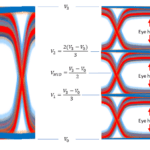
An eye diagram is a powerful visualization tool in digital communications and high-speed electronics to assess signal quality and channel performance. This FAQ will briefly explain an eye diagram and the overall and specific metrics engineers should know to understand an eye diagram. When capturing signals from a digital bitstream such as Ethernet or USB, […]

Filed Under: FAQ, Featured Tagged With: FAQ

How to determine noise figure: part 1

October 28, 2024 By Rick Nelson Leave a Comment

A noise figure consolidates the effects of various noise types to provide a single specification for the noise performance of a component or system. In electronic circuits and systems, noise is an undesirable, inevitable disturbance in currents and voltages. Noise has many underlying fundamental causes. Thermal noise, also known as Johnson–Nyquist noise, results from random […]

Filed Under: FAQ, Featured Tagged With: FAQ

How to interpret a QAM display: part 3

October 9, 2024 By Rick Nelson Leave a Comment

Error vector magnitude characterizes actual QAM signals’ deviations from their ideal locations due to nonlinearity and phase noise. In part 1 of this series, we discussed quadrature amplitude modulation (QAM), which results from summing orthogonal amplitude-modulated cosine and sine waves of the same frequency. In part 2, we looked at assigning bit sequences to QAM […]

Filed Under: FAQ, Featured Tagged With: FAQ

  • « Go to Previous Page
  • Page 1
  • Page 2
  • Page 3
  • Page 4
  • Page 5
  • Interim pages omitted …
  • Page 41
  • Go to Next Page »

Primary Sidebar

Featured Contributions

Why engineers need IC ESD and TLP data

Verify, test, and troubleshoot 5G Wi-Fi FWA gateways

How to build and manage a top-notch test team

How to use remote sensing for DC programmable power supplies

The factors of accurate measurements

More Featured Contributions

EE TECH TOOLBOX

“ee
Tech Toolbox: Power Efficiency
Discover proven strategies for power conversion, wide bandgap devices, and motor control — balancing performance, cost, and sustainability across industrial, automotive, and IoT systems.

EE TRAINING CENTER

EE Learning Center
“test
EXPAND YOUR KNOWLEDGE AND STAY CONNECTED
Get the latest info on technologies, tools and strategies for EE professionals.
bills blog

RSS Current Electro-Tech-Online.com Discussions

  • ESP32-S3 started outputting NMEA GPS location frames after EMC disturbance — what mode is this?
  • TraxMaker Pro? I only have the non-Pro version. Looking for the Pro version that has the integrated pick and place coordinates export.
  • Can a small solar panel safely trickle-charge old NiMH AA batteries?
  • desoldering
  • Need a fresh eye on my first PCB

Footer

EE World Online Network

  • 5G Technology World
  • EE World Online
  • Engineers Garage
  • Analog IC Tips
  • Battery Power Tips
  • Connector Tips
  • EDA Board Forums
  • Electro Tech Online Forums
  • EV Engineering
  • Microcontroller Tips
  • Power Electronic Tips
  • Sensor Tips

Test & Measurement Tips

  • Subscribe to our newsletter
  • Advertise with us
  • Contact us
  • About us

Copyright © 2025 · WTWH Media LLC and its licensors. All rights reserved.
The material on this site may not be reproduced, distributed, transmitted, cached or otherwise used, except with the prior written permission of WTWH Media.

Privacy Policy