• Skip to primary navigation
  • Skip to main content
  • Skip to primary sidebar
  • Skip to footer
  • Advertise
  • Subscribe

Test & Measurement Tips

Oscilloscopes, electronics engineering industry news, how-to EE articles and electronics resources

  • Oscilloscopes
    • Analog Oscilloscope
    • Digital Oscilloscope
    • Handheld Oscilloscope
    • Mixed-signal Oscilloscope
    • PC-based Oscilloscopes – PCO
  • Design
  • Calibration
  • Meters & Testers
  • Test Equipment
  • Learn
    • eBooks/Tech Tips
    • FAQs
    • EE Training Days
    • Learning Center
    • Tech Toolboxes
    • Webinars & Digital Events
  • Video
    • EE Videos
    • Teardown Videos
  • Resources
    • Design Guide Library
    • Digital Issues
    • Engineering Diversity & Inclusion
    • Leap Awards
    • White Papers
  • Subscribe
You are here: Home / Test Equipment / What is Schumann resonance?

What is Schumann resonance?

May 9, 2016 By David Herres Leave a Comment

The space between the earth’s surface and the ionosphere comprises a large resonant cavity, which has the ability to output energy at a specific frequency. Like any resonant cavity, the frequency of the energy depends on the size of the cavity. Larger size translates to lower frequency, i.e. longer wavelength.

The ionosphere is composed of atoms that have had electrons forcibly knocked out of orbit by the strong ambient solar radiation. When a neutral atom loses an electron, it becomes a positively charged ion. The ionosphere is highly reflective, forming the upper boundary of the Schumann resonant cavity.

A point to consider is the fact that energy from an outside source must be injected into the cavity if there is to be an output. A laser is similar, where the outside energy is introduced by means of a laser pump, powered by an energy source ranging from an AAA dry cell to a nuclear reactor.

In Schumann resonance from the large ground-to-ionosphere cavity, the frequency is low with a fundamental at 7.83 Hz. The energy source is moderate, with power coming from naturally occurring lightning.

The fundamental is a standing wave, caused by interference between waves reflected back and forth at the cavity’s resonant frequency. Its wavelength is equal to the earth’s circumference.

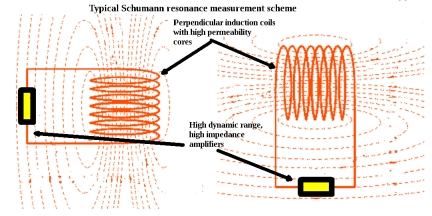
Due to the low frequency, it has been difficult to differentiate Schumann resonances from background noise. The Schumann resonances are not high-powered events; the accompanying magnetic field is far smaller in amplitude than the earth’s magnetic field. For this reason, it takes specialized equipment to detect these phenomena. Sensitive antennas and receivers, suitably tuned, are connected to high-impedance amplifiers, with electromagnets consisting of many turns of super-fine wire wound about soft iron cores.
schumann resonance measurement
Typical Schumann resonance measurement gear uses induction coils set up horizontally in
two directions perpendicular to each other to account for
the polarization of the magnetic waves. The signal has a low amplitude, so coils in the range of 10k turns with high-permeability cores are necessary.

The primary application for this instrumentation is to measure and record global lightning activity. Lightning on planets other than earth and on Titan, the largest of Saturn’s moons, is suggested in some cases by observations from earth of radio emission spectra consistent with Schumann resonances. But actual confirmation will await closer observation because of the relatively weak nature of the manifestations.

Filed Under: Test Equipment

Reader Interactions

Leave a Reply Cancel reply

You must be logged in to post a comment.

Primary Sidebar

Featured Contributions

impedance plot

How physics relates signal integrity, power integrity, and EMC

Why engineers need IC ESD and TLP data

Verify, test, and troubleshoot 5G Wi-Fi FWA gateways

How to build and manage a top-notch test team

How to use remote sensing for DC programmable power supplies

More Featured Contributions

EE TECH TOOLBOX

“ee
Tech Toolbox: Sensors
In this Tech Toolbox, we cover some of those technologies driving the next generation of connected systems, including ultra-low-power sensing strategies that extend node battery life, and 60 GHz CMOS radar for contactless health and presence detection.

EE TRAINING CENTER

EE Learning Center
“test
EXPAND YOUR KNOWLEDGE AND STAY CONNECTED
Get the latest info on technologies, tools and strategies for EE professionals.
bills blog

RSS Current Electro-Tech-Online.com Discussions

  • Battery discharger
  • Relay question
  • Phone Charger 5v to 12v
  • reviving old swordfish program but?
  • Assistance locating a 'trail' camera gadget, please ?

Footer

EE World Online Network

  • 5G Technology World
  • EE World Online
  • Engineers Garage
  • Analog IC Tips
  • Battery Power Tips
  • Connector Tips
  • EDA Board Forums
  • Electro Tech Online Forums
  • EV Engineering
  • Microcontroller Tips
  • Power Electronic Tips
  • Sensor Tips

Test & Measurement Tips

  • Subscribe to our newsletter
  • Advertise with us
  • Contact us
  • About us

Copyright © 2026 · WTWH Media LLC and its licensors. All rights reserved.
The material on this site may not be reproduced, distributed, transmitted, cached or otherwise used, except with the prior written permission of WTWH Media.

Privacy Policy