• Skip to primary navigation
  • Skip to main content
  • Skip to primary sidebar
  • Skip to footer
  • Advertise
  • Subscribe

Test & Measurement Tips

Oscilloscopes, electronics engineering industry news, how-to EE articles and electronics resources

  • Oscilloscopes
    • Analog Oscilloscope
    • Digital Oscilloscope
    • Handheld Oscilloscope
    • Mixed-signal Oscilloscope
    • PC-based Oscilloscopes – PCO
  • Design
  • Calibration
  • Meters & Testers
  • Test Equipment
  • Learn
    • eBooks/Tech Tips
    • FAQs
    • EE Training Days
    • Learning Center
    • Tech Toolboxes
    • Webinars & Digital Events
  • Video
    • EE Videos
    • Teardown Videos
  • Resources
    • Design Guide Library
    • Digital Issues
    • Engineering Diversity & Inclusion
    • Leap Awards
    • White Papers
  • Subscribe
You are here: Home / Test Equipment / Basics of cloud chambers

Basics of cloud chambers

March 25, 2016 By David Herres Leave a Comment

A tabletop cloud chamber is a simple home project that can be built, and can detect and display condensation trails that develop in the presence of ionizing radiation. It was invented by Charles Wilson, who perfected a working model in 1911. For many decades it was used by researchers and it played an important role in the discovery of elementary particles and atomic ions.
cloud chamber
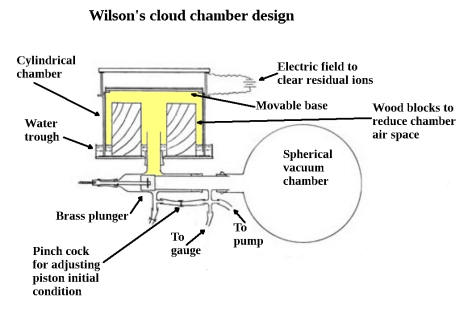
Wilson’s original cloud chamber was a glass cylinder, about 16 cm across and about 3 cm deep. Its walls were coated in gelatin, with the base dyed black for a photographic dark background. The floor of the chamber was fixed to the top of a brass plunger. It all stood in a shallow trough of water that kept air in the chamber saturated with water. A diaphragm was used to expand the air in the chamber for adiabatic expansion, cooling the air and starting to condense water vapor. This kind of chamber is called a pulsed chamber because the conditions for operation are not continuously maintained.

Around 1960 the cloud chamber was superseded by the more sensitive bubble chamber, which uses liquid hydrogen. Because bubble chambers are filled with much-denser liquid material, they reveal the tracks of much more energetic particles. Finally, the spark chamber came along, where voltage is applied to a grid of electrical wires. The ionized trails cause electrical sparks to jump from wire to wire, forming the display that indicates the presence of ionizing radiation. The location of the sparks is generally stored for later analysis by computer.

A traditional cloud chamber must incorporate a steep temperature gradient. This is created by means of dry ice (frozen CO2) and methyl alcohol inside a sealed container made transparent so the particle trails can be viewed from outside.

The dry ice sits at the bottom of the chamber, and an absorbent pad saturated with methanol is placed at the top. To see the particle trails it is necessary to shut off the lights. The chamber is illuminated from the side–home project cloud chambers can use a strong flashlight. You will see an incredible fast-moving display of particle tracks.

The way a chamber works is when a particle passes through, it accumulates condensation, in essence a visible cloud. What you are seeing, of course, is not the infinitesimal particle, but the large vapor trail that has attached to it.

More specifically, the trail arises because of the many ions produced along the path of the charged particle. These tracks have distinctive shapes. For example, an alpha particle has a broad track and shows more evidence of deflection by collisions. A track made by an electron is thinner and straight. Applying a uniform magnetic field across the cloud chamber curves positively and negatively charged particles in opposite directions, as described by the Lorentz force law with two particles of opposite charge.

In particle and nuclear physics research facilities, particle detectors have evolved considerably from Wilson’s simple cloud chamber. Besides gaseous ionization detectors, there are semiconductor detectors including CCDs and scintillation detectors. At CERN, for the Large Hadron Collider, dedicated detectors have been built for specific projects, most notably in the great quest for the Higgs Boson.

An excellent demonstration including instructions for building a cloud chamber using readily available materials may be seen at https://www.youtube.com/watch?v=xky3f1aSkB8.

Filed Under: Test Equipment

Reader Interactions

Leave a Reply Cancel reply

You must be logged in to post a comment.

Primary Sidebar

Featured Contributions

impedance plot

How physics relates signal integrity, power integrity, and EMC

Why engineers need IC ESD and TLP data

Verify, test, and troubleshoot 5G Wi-Fi FWA gateways

How to build and manage a top-notch test team

How to use remote sensing for DC programmable power supplies

More Featured Contributions

EE TECH TOOLBOX

“ee
Tech Toolbox: Sensors
In this Tech Toolbox, we cover some of those technologies driving the next generation of connected systems, including ultra-low-power sensing strategies that extend node battery life, and 60 GHz CMOS radar for contactless health and presence detection.

EE TRAINING CENTER

EE Learning Center
“test
EXPAND YOUR KNOWLEDGE AND STAY CONNECTED
Get the latest info on technologies, tools and strategies for EE professionals.
bills blog

RSS Current Electro-Tech-Online.com Discussions

  • Battery discharger
  • Relay question
  • Phone Charger 5v to 12v
  • reviving old swordfish program but?
  • Assistance locating a 'trail' camera gadget, please ?

Footer

EE World Online Network

  • 5G Technology World
  • EE World Online
  • Engineers Garage
  • Analog IC Tips
  • Battery Power Tips
  • Connector Tips
  • EDA Board Forums
  • Electro Tech Online Forums
  • EV Engineering
  • Microcontroller Tips
  • Power Electronic Tips
  • Sensor Tips

Test & Measurement Tips

  • Subscribe to our newsletter
  • Advertise with us
  • Contact us
  • About us

Copyright © 2026 · WTWH Media LLC and its licensors. All rights reserved.
The material on this site may not be reproduced, distributed, transmitted, cached or otherwise used, except with the prior written permission of WTWH Media.

Privacy Policy