• Skip to primary navigation
  • Skip to main content
  • Skip to primary sidebar
  • Skip to footer
  • Advertise
  • Subscribe

Test & Measurement Tips

Oscilloscopes, electronics engineering industry news, how-to EE articles and electronics resources

  • Oscilloscopes
    • Analog Oscilloscope
    • Digital Oscilloscope
    • Handheld Oscilloscope
    • Mixed-signal Oscilloscope
    • PC-based Oscilloscopes – PCO
  • Design
  • Calibration
  • Meters & Testers
  • Test Equipment
  • Learn
    • eBooks/Tech Tips
    • FAQs
    • EE Training Days
    • Learning Center
    • Tech Toolboxes
    • Webinars & Digital Events
  • Video
    • EE Videos
    • Teardown Videos
  • Resources
    • Design Guide Library
    • Digital Issues
    • Engineering Diversity & Inclusion
    • Leap Awards
    • White Papers
  • Subscribe
You are here: Home / Test Equipment / Instron Introduces Universal Testing Machines

Instron Introduces Universal Testing Machines

October 30, 2009 By Test and Measurement Editor 1 Comment

5900 Series Load Frames are built with robust ball screws, precision guidance columns, and dual-belt drive systems

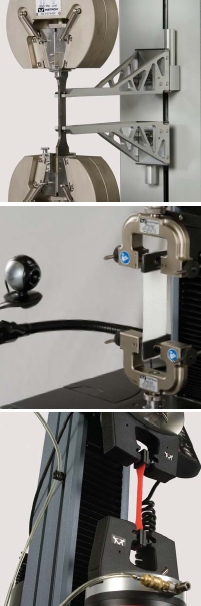
Instron, announced its new line of universal materials testing equipment.  The 5900 Series has improved ergonomics, accuarcy, and reliability as well as an enhanced overall experience for the operator.

The single column tabletop systems, with a small footprint ideal for lab use, are designed for low-force testing up to 2 kN. These systems are commonly used for medical devices and biomaterials, textiles, small components and electronics, food, paper, and plastic films. The dual column tabletop systems are ideal for mid-range testing. With testing capacities up to 50 kN, these multi-purpose tabletop instruments meet the requirements of a variety of industries, and are commonly used for plastics, metals, and rubber. The dual column floor model systems are built for high-capacity testing up to 600 kN. These robust, heavy-duty frames are ideal for demanding applications including testing of high-strength metals and alloys, advanced composites, aerospace and automotive structures, and more.

The servo-control and signal conditioning electronics are designed by Instron specifically for materials testing applications. Their proprietary load cell design allows us to control all facets of force measurement – the most critical aspect of mechanical testing. The cutting-edge load cell construction ensures that our systems achieve their maximum level of performance. Additionally, our significant investment in primary force calibration standards and a factory-based calibration laboratory allows us to offer capabilities normally found only in a National Standards laboratory.

5900 Series Load Frames are built with robust ball screws, precision guidance columns, and dual-belt drive systems, and are designed to provide higher stiffness and precise alignment for testing everything from medical devices to high-strength composites. The rigid mechanical design ensures the best possible conditions for repeatable test conditions and reliable results, and is the primary reason why Instron systems last for decades.

The 5900 Series operates on Bluehill 2 Software and a control panel that contains customizable soft keys and live displays that monitor real-time data from any two channels (e.g. load, extension, tensile stress). Tests can easily be run directly from the control panel, resulting in greater overall testing efficiency.

http://www.instron.us/

Filed Under: Test Equipment

Reader Interactions

Comments

  1. Louis Morel says

    April 18, 2012 at 12:03 pm

    How does a visitor to your site remove the annoying floating bar that contains links to Facebook, Twitter and Linked In? It prevents your guest from reading all of the text that you have painstakingly provided. I gave up.

    Log in to Reply

Leave a Reply Cancel reply

You must be logged in to post a comment.

Primary Sidebar

Featured Contributions

impedance plot

How physics relates signal integrity, power integrity, and EMC

Why engineers need IC ESD and TLP data

Verify, test, and troubleshoot 5G Wi-Fi FWA gateways

How to build and manage a top-notch test team

How to use remote sensing for DC programmable power supplies

More Featured Contributions

EE TECH TOOLBOX

“ee
Tech Toolbox: Sensors
In this Tech Toolbox, we cover some of those technologies driving the next generation of connected systems, including ultra-low-power sensing strategies that extend node battery life, and 60 GHz CMOS radar for contactless health and presence detection.

EE TRAINING CENTER

EE Learning Center
“test
EXPAND YOUR KNOWLEDGE AND STAY CONNECTED
Get the latest info on technologies, tools and strategies for EE professionals.
bills blog

RSS Current Electro-Tech-Online.com Discussions

  • Battery discharger
  • Relay question
  • Phone Charger 5v to 12v
  • reviving old swordfish program but?
  • Assistance locating a 'trail' camera gadget, please ?

Footer

EE World Online Network

  • 5G Technology World
  • EE World Online
  • Engineers Garage
  • Analog IC Tips
  • Battery Power Tips
  • Connector Tips
  • EDA Board Forums
  • Electro Tech Online Forums
  • EV Engineering
  • Microcontroller Tips
  • Power Electronic Tips
  • Sensor Tips

Test & Measurement Tips

  • Subscribe to our newsletter
  • Advertise with us
  • Contact us
  • About us

Copyright © 2026 · WTWH Media LLC and its licensors. All rights reserved.
The material on this site may not be reproduced, distributed, transmitted, cached or otherwise used, except with the prior written permission of WTWH Media.

Privacy Policy