Work on resistance measurement, described in An Elementary Treatise on Electricity, helped pave the way to successful trans-Atlantic telegraphy.
In Part 1, I discussed An Elementary Treatise on Electricity by James Clerk Maxwell. One volume made national news earlier this summer when it was returned to New Bedford, Mass. Free Public Library 115 years overdue. I became interested in what Maxwell and his editor, who published the book posthumously in 1881, were interested in at the time. According to the preface to an 1888 edition, the goal of the original was a comprehensive discussion of the electrical measurement capabilities of the time.
You mentioned a “killer app” of the late 19th century and the relevance of the material in the book.
Trans-Atlantic Telegraphy was that killer app. To link Newfoundland and Ireland, U.S. entrepreneur Cyrus W. Field enlisted technical assistance from Samuel F.B. Morse and Edward Orange Wildman Whitehouse as well as William Thomson (later Lord Kelvin). Discord entered the project from the beginning. Morse, a painter who had remarkable success at terrestrial telegraphy, and Whitehouse, a medical doctor, had no formal experience with electricity. Nevertheless, they confidently recommended a small-diameter cable and high-voltage transmission. Thomson, the son of a math and engineering teacher who maintained a focus on the subjects throughout his life, recommended a low-resistance, large-diameter cable with a sensitive receiver in the form of a mirror galvanometer.
Field proceeded with the small-diameter, low-initial-cost cable and succeeded in linking Ireland and Newfoundland in 1858. The cable allowed Queen Victoria and US President James Buchanan to exchange pleasantries at a throughput of about 98 words per 16 hours. The cable carried several hundred other messages over the next few weeks before failing completely. The failure set back the cause of the trans-Atlantic telegraphy by many years.
How did Maxwell contribute to the effort’s ultimate success?
Thomson had determined that cable “retardation” (a combination of capacitance and resistance) could degrade throughput. Consequently, Maxwell and others realized the significance of understanding parameters such as resistance. “It is of the utmost importance in the electric telegraph that the metal of which the wires are made should have the smallest attainable resistance,” Maxwell writes in an excerpt from A Treatise on Electricity and Magnetism reprinted in An Elementary Treatise on Electricity. “Measurements of resistance must therefore be made before selecting the materials.” Dielectrics were also of concern, and Maxwell tabulates the resistance of a cubic meter of gutta-percha, a common insulator used at the time, deployed in locations including the Red Sea and the Persian Gulf.
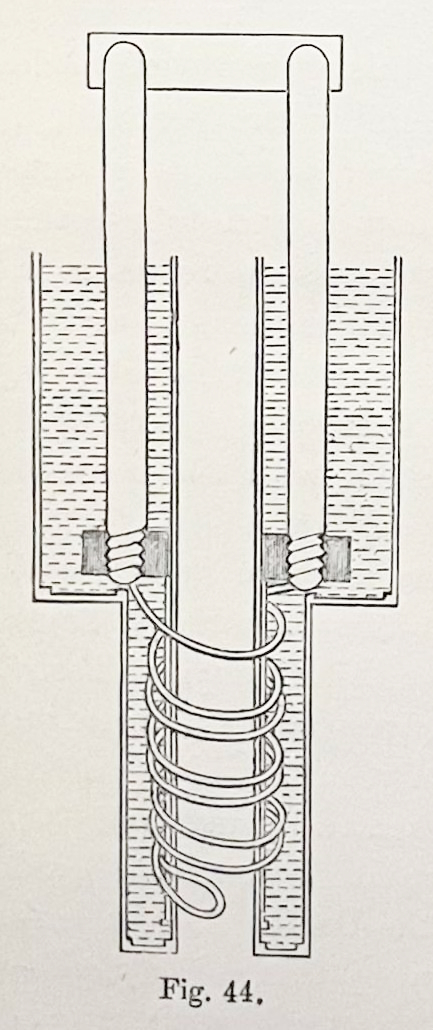
Maxwell joined the British Association Committee on Electrical Standards charged with defining units suitable for use by telegraphy engineers. After painstaking experimentation and measurement, the committee issued its resistance standard in 1865 (1867 saw the adoption of the symbol W).
Figure 1 (Figure 44 in An Elementary Treatise on Electricity) shows a 1-W resistance standard. Such standards included resistance coils made up of an alloy of two parts silver and one part platinum with wire diameters ranging from 0.5 to 0.8 mm and 1 m to 2 m in length, with Maxwell adding, “These wires were soldered to stout copper electrodes. The wire itself was covered with two layers of silk, embedded in solid paraffin, and enclosed in a thin brass case, so that it can be easily brought to a temperature at which its resistance is accurately one Ohm.”
What happened next?
The efforts on experimental measurements and standardization persuaded investors to try again, and Field was able to complete a successful trans-Atlantic cable in 1866. The effort was also a boon for electrical engineering, as investors sought focused expertise while avoiding putting their money behind potential one-hit wonders like Morse. In 1882, Darmstadt Technical University founded the first chair, and the first faculty of electrical engineering, and MIT established electrical engineering as an option within the physics department.
So, telegraphy drove what we know as electrical engineering today?
Well, there was another important “app” in the 19th century. In 1882, Thomas Edison established a central electric power station in lower Manhattan. To fulfill his need for skilled workers, he asked Columbia College to establish an electrical-engineering department. After seven years of consideration, the college complied. The Figure 2 timeline extends from the development of the Morse code in 1838 to MIT’s establishment of an independent Department of Electrical Engineering in 1902.

Where can I read more?
“The First Transatlantic Telegraph Cable Was a Bold, Beautiful Failure” (Spectrum)
Transatlantic Cables and the Ohm (James Clerk Maxwell Foundation)
“Maxwell’s contribution to standardising the unit of electrical resistance” (Newsletter of the James Clerk Maxwell Foundation)
“Perseverance pays off: The Transatlantic Telegraph Cable” (Civil Engineering Magazine)
Darmstadt Technical University “Department of Electrical Engineering and Information Technology (etit)”
“The birth of electrical engineering”(MIT News)
MIT Electrical Engineering and Computer Science “Departmental History”
“A Brief History of Columbia’s Electrical Engineering Department, 1889-1975”
IMS 2023: keynote analyzes early undersea cables, video of Ed Godshalk’s keynote address explaining the engineering behind the undersea cables.



Leave a Reply
You must be logged in to post a comment.