• Skip to primary navigation
  • Skip to main content
  • Skip to primary sidebar
  • Skip to footer
  • Advertise
  • Subscribe

Test & Measurement Tips

Oscilloscopes, electronics engineering industry news, how-to EE articles and electronics resources

  • Oscilloscopes
    • Analog Oscilloscope
    • Digital Oscilloscope
    • Handheld Oscilloscope
    • Mixed-signal Oscilloscope
    • PC-based Oscilloscopes – PCO
  • Design
  • Calibration
  • Meters & Testers
  • Test Equipment
  • Learn
    • eBooks/Tech Tips
    • FAQs
    • EE Training Days
    • Learning Center
    • Tech Toolboxes
    • Webinars & Digital Events
  • Video
    • EE Videos
    • Teardown Videos
  • Resources
    • Design Guide Library
    • Digital Issues
    • Engineering Diversity & Inclusion
    • Leap Awards
    • White Papers
  • Subscribe

Bill Schweber

What is intersymbol interference — and why should I care about it?

July 16, 2025 By Bill Schweber Leave a Comment

Real-world digital signals and their channels are characterized by complex equations that lead to improved link performance. When engineers think or talk about digital signals, there’s often the sense that these are nice rectangular pulses with right-angle squared-off corners, but that’s only in the ideal world. In the real world, signal challenges begin with how […]

Filed Under: FAQ, Featured Tagged With: FAQ

Untangling accuracy, precision, and resolution, Part 2: Implications

January 16, 2023 By Bill Schweber Leave a Comment

Accuracy, precision, and resolution are key parameters, each with a distinct meaning and implication with respect to system design and confidence. Design, test, and measurement implications Low or moderate accuracy may seem a detriment, but that isn’t necessarily the case. If precision is good enough and there is a way to calibrate the readings, the […]

Filed Under: FAQ, Featured, New Articles Tagged With: FAQ

Untangling accuracy, precision, and resolution, Part 1: Basics
January 12, 2023 By Bill Schweber Leave a Comment

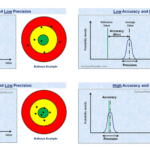
Accuracy, precision, and resolution are key parameters, each with a distinct meaning and implication with respect to system design and confidence. To the average person, terms such as accuracy and precision are somewhat interchangeable, and that’s fine. However, they have very specific and different meanings as well as design and test implications for scientists, engineers, […]

Filed Under: FAQ, Featured, New Articles Tagged With: FAQ

What is “orthogonal”? (Part 4): eye diagrams

May 10, 2022 By Bill Schweber Leave a Comment

The phrase and concept “orthogonal” is widely used in engineering, but it is also often misunderstood. Just as both the time domain and frequency domain are two legitimate ways of looking at a signal from different perspectives linked by the Fourier transform, the constellation diagram has a time-domain complement called the eye diagram or eye […]

Filed Under: FAQ, Featured Tagged With: FAQ

What is “orthogonal”? (Part 3): signal constellations
May 9, 2022 By Bill Schweber Leave a Comment

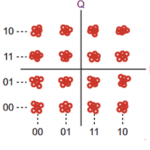
The phrase and concept “orthogonal” is widely used in engineering, but it is also often misunderstood. We can look at orthogonal signals in multiple ways: in the time domain, the frequency domain, as a constellation – a presentation which is widely used in the broad discipline referred to as signal processing, and as an eye […]

Filed Under: FAQ, Featured Tagged With: FAQ

What is “orthogonal”? (Part 2): signal space
May 9, 2022 By Bill Schweber Leave a Comment

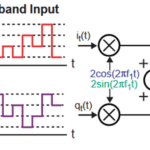
The phrase and concept “orthogonal” is widely used in engineering, but it is also often misunderstood. The formal definition of orthogonal signals does not necessarily mean that they are unrelated or uncorrelated, although that is how the term is often used in casual “engineering speak.” Formally, two vectors are orthogonal if their dot product is […]

Filed Under: FAQ, Featured, New Articles Tagged With: FAQ

What is “orthogonal”? (Part 1): mechanical design 

May 4, 2022 By Bill Schweber Leave a Comment

orthogonal

The phrase and concept “orthogonal” is widely used in engineering, but it is also often misunderstood. I was chatting the other day with a non-technical friend and said something like, “Oh, that won’t happen. Those two things are orthogonal.” My friend looked at me and replied with a “huh?” and he was right to do […]

Filed Under: FAQ, Featured Tagged With: FAQ

Digital caliper, Pt 2: Implementation and extensions
February 18, 2019 By Bill Schweber 2 Comments

Use of electronics and capacitive-based position sensing have transformed the caliper, a fundamental and essential instrument of precision linear-dimension measurement. Part 1 of this FAQ looked briefly at the basic mechanical, Vernier, and dial-readout calipers, as well as the micrometer. All these mechanical-only embodiments of the caliper were made obsolete within a few years with […]

Filed Under: Calibration, FAQ, Featured Tagged With: autodeskinc, basics, cuiinc, FAQ, mitutoyoamerica, mscindustrialdirectco

Digital caliper, Pt 1: Background and predecessors
February 11, 2019 By Bill Schweber Leave a Comment

Use of electronics and capacitive-based position sensing have transformed the caliper, a fundamental and essential instrument of precision linear-dimension measurement. Making precise measurements across small distances of up to several inches or tens of centimeters is an obvious and fundamental requirement of modern metrology, research, and mass production. But how can that be done accurately, […]

Filed Under: Calibration, FAQ, Featured, Meters & Testers Tagged With: basics, FAQ, mitutoyoamerica, mscindustrialdirectco, oshluninc

Primary Sidebar

Featured Contributions

antenna array

Verifying 5G with OTA testing

You passed: Getting products through EMC/EMI compliance tests

screen-shot-display--Chroma-63200A

How to test dc-dc converters

More Featured Contributions

EE TECH TOOLBOX

“ee
Tech Toolbox: Sensors
In this Tech Toolbox, we cover some of those technologies driving the next generation of connected systems, including ultra-low-power sensing strategies that extend node battery life, and 60 GHz CMOS radar for contactless health and presence detection.

EE TRAINING CENTER

EE Learning Center
“test
EXPAND YOUR KNOWLEDGE AND STAY CONNECTED
Get the latest info on technologies, tools and strategies for EE professionals.
bills blog

RSS Current Electro-Tech-Online.com Discussions

  • Voltage comparator circuit verification
  • What is this???
  • Why aren’t the power windows in my 2006 Volkswagen Polo 2006 working despite repairing the control unit circuit board?
  • infiniBand Layer 1 specifications testing question
  • block RF

Footer

EE World Online Network

  • 5G Technology World
  • EE World Online
  • Engineers Garage
  • Analog IC Tips
  • Battery Power Tips
  • Connector Tips
  • EDA Board Forums
  • Electro Tech Online Forums
  • EV Engineering
  • Microcontroller Tips
  • Power Electronic Tips
  • Sensor Tips

Test & Measurement Tips

  • Subscribe to our newsletter
  • Advertise with us
  • Contact us
  • About us

Copyright © 2026 · WTWH Media LLC and its licensors. All rights reserved.
The material on this site may not be reproduced, distributed, transmitted, cached or otherwise used, except with the prior written permission of WTWH Media.

Privacy Policy