Fluke 125 Industrial ScopeMeter delivers 25 MS/s
December 16, 2011 by Test and Measurement Editor
Filed under Handheld Oscilloscope, Oscilloscopes
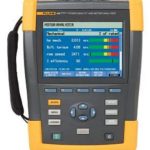
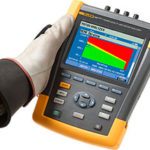
Fluke (www.fluke.com) has introduced a 40 MHz oscilloscope that combines the functionality of two true-RMS multimeters, a dual input TrendPlot recorder and an oscilloscope in one compact, battery powered device.
Featuring two input channels, the Fluke 125 Industrial ScopeMeter offers a maximum real-time sampling rate of 25 MS/s and a record length of up to 512 pts per input.
The Fluke 125 measures 232 x 115 x 50 mm and weighs only 1.2 kg. It also provides up to seven hours of continuous battery operation, freeing users from main outlets for on-the-move working.
The oscilloscope wastes no time in finding or swapping leads as its high frequency meter-, waveform-, resistance- and capacitance-measurements and continuity checks are covered by the shielded test leads.
Its bus health tester automatically analyzes the network’s electric signals to provide waveform data as well as measure individual parameters. The measurement results will be compared to the standard results with the “good” or “false” indicators displayed on every parameter.
Unlike traditional oscilloscopes that only make measurements referenced to the power line ground, the compact Fluke 125 oscilloscope makes floating measurements. This eliminates the risk of ground short circuit when making the connection.
The oscilloscope’s TrendPlot recorder enables users to view intermittent faults caused by dust, bad connections, corrosion, dirt or simply by broken connectors or wiring. In this mode, users can plot the maximum and minimum peak values. In addition, the oscilloscope’s two inputs can also plot any combination of amps, volts, frequency, temperature and phase with date and time stamp, to help users to easily determine the root cause of the faults.
Fluke 190-062 Color ScopeMeter offers rugged portability
December 7, 2011 by Test and Measurement Editor
Filed under Digital Oscilloscope, Handheld Oscilloscope, Oscilloscopes
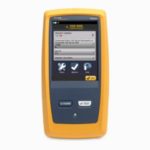
Fluke (www.fluke.com) has introduced a 60 MHz dual channel oscilloscope that combines the rugged portability and highest safety rating with the performance of a benchtop oscilloscope. Featuring a maximum real-time sampling rate of 625 MS/s, the Fluke 190-062 Color ScopeMeter is specifically designed for technicians and plant engineers.
Built for harsh environments, the rugged and shock-proof portable oscilloscope also features a sealed case that protects it from water vapor, dust, humidity, dips and airborne pollutants, ensuring that it delivers reliable accurate performance.
In addition, the Fluke 190-062 seamlessly blends the functionality of a high performance oscilloscope, paperless recorder and multimeter in one portable package.
This easy-to-use oscilloscope offers double-insulated input channels that are safety rated suitable for measurements in CAT III 1000V/CAT IV 600V environments.
With three-dimensional testing capability for industrial systems, the oscilloscope allows users to simultaneously inspect input signals, safety interlocks of output feedback loops to identify a range of problems, such as signal timing measurements and synchronization issues, circuit voltage/current overloading, signal fluctuation/drift and attenuation/input impedance mismatch.
Its high-performance batteries benefits from Li-ion technology, which allows the oscilloscope to continuously operate for up to four hours. The oscilloscope’s easy-access battery door allows for fast and easy battery swaps.
The Fluke 190-062 comes with two USB ports that allow users to conveniently connect to a PC or any USB memory devices, and store unlimited screen captures, waveform and instrument setups. Its FlukeView software for windows enables users to transfer as well as archive critical measurement data via a PC USB interface.
Fluke Wins TED Magazine 2011 Best of the Best Award
August 29, 2011 by Test and Measurement Editor
Filed under New Articles
Fluke Corporation was named a winner in the Digital Campaign category of the TED Magazine 2011 Best of the Best Awards. The awards recognize the best marketing practices in the electrical industry.
Fluke won for the “It’s a Tight, Tight World” online promotion for the iFlex Clamp Meter. The program featured a humorous video featuring the iFlex product. After viewing the video, participants received a personalized link, which they used to share the video via email, Facebook, Twitter, and other social media sites. If their link to the video was used five times, they received an iFlex bottle opener as a prize.
Forty percent of the video’s 30,000 views resulted from participant sharing, exceeding the average of 15 percent for similar programs. The program was an effort at engaging a broad audience through non-traditional media and it successfully generated significant awareness for the iFlex Clamp Meter.
This is the sixth major recognition this year for the Fluke Clamp Meters. The Fluke 381 Remote Display True-rms AC/DC Clamp Meter with iFlex won the EC&M 2011 Platinum Product of the Year, EC&M 2011 Product of the Year Category Winner in the portable measurement equipment category, Gold Award in the Tools category in the ACHR – The NEWS 8th Annual Dealer Design Awards, 2010 Control Engineering Engineers’ Choice Awards in the portable measurement equipment category, and 2010 Plant Engineering Product of the Year Silver Award in the Maintenance Tools
and Equipment category.

Fluke Corporation
www.fluke.com
Fluke 124 Industrial ScopeMeter
June 10, 2011 by Test and Measurement Editor
Filed under Handheld Oscilloscope, Oscilloscopes
Fluke (www.fluke.com) has introduced an oscilloscope that meets the demands of industrial and plant engineers who constantly measure and check waveforms of complex systems — the Fluke 124 ScopeMeter. Simplifying the detection of signal anomalies, glitches and dropouts that cause the deterioration of a machine, this dual channel oscilloscope features 40 MHz of bandwidth.
Offering a rugged solution for industrial installation and troubleshooting applications, Fluke 124 seamlessly combines a digital storage oscilloscope, dual input TrendPlot recorder and two true-RMS digital multimeters in a single compact, battery powered device.
Fluke 124 comes in a drip proof and rugged housing that ensures long life and reliable operation even in the harshest industrial environments. This 1.2 kg oscilloscope offers up to seven hours of continuous battery operation, freeing the user from main outlets for on-the-move assignments.
Unlike traditional oscilloscopes that can only take measurements referenced to power line ground, Fluke 124 has the ability to make floating measurements. This effectively eliminates the risk of accidental ground short circuit.
The optically isolated USB or RS-232 interface allows the oscilloscope to conveniently connect to a printer or to a PC for direct print-out or documentation and analysis using FlukeView software.
The most difficult faults to locate are those that occur only once in a while. Known as intermittents, they are attributed to dust, bad connections, dirt, broken wiring or connectors and corrosion. Users may not be around when it happen, but the Fluke 124 will. In its paperless recorder mode, the oscilloscope can plot maximum and minimum peak values and averages for up to 16 days. These two inputs help users locate faults easily since it can plot any combinations of amps, volts, frequency, temperature and phase with date and time stamp.
Fluke introduces additions to 190 Series II ScopeMeter
June 2, 2011 by Test and Measurement Editor
Filed under Handheld Oscilloscope, Oscilloscopes
Fluke (www.fluke.com) has announced the three new additions to its portfolio of portable, rugged, handheld 190 Series II ScopeMeter — the Fluke 190-202, 190-062 and 190-102.
These two channel oscilloscopes deliver 200 MHz, 60 MHz and 100 MHz respectively, maximum real-time sampling rate of 2.5 GS/s and 400 pico seconds resolution. These features complement the newly introduced four-channel Fluke 190-104 and Fluke 190-204 Series II ScopeMeters, which are also known to be the first oscilloscopes to offer a safety rating of 1000V CAT III / 600V CAT IV and provide a harmonious combination of ruggedness and performance in the field.
Specifically developed for the industrial plant maintenance professional installing, servicing and maintaining electro-mechanical machinery, heavy duty electrical equipment and plant automation control systems, they can be safely utilized on an electrical distribution system’s permanently installed industrial equipment.
The three new additions to the series offers various features aimed at enhancing productivity. Its Connect&View feature enables hands-free operation, delivering a stable, immediate display for capturing as well as displaying complex waveforms for faster fault finding. The models’ TrendPlot recording function helps users uncover long-term trends and reveals changes in the measurable parameters, while Frequency Spectrum Analysis function using FFT helps identify frequency components of a signal. The ScopeRecord feature also enables users to record waveforms for up to 48 hours. Meanwhile, a “Replay” function gives users a closer look of the anomaly viewed on the screen, by re-playing the last series of 100 screen images.
Designed for use in harsh environments, the new Fluke 190 Series II ScopeMeters comes in IP51 rated sealed casing.
Fluke releases 192C/S Color ScopeMeter
March 1, 2011 by Test and Measurement Editor
Filed under Handheld Oscilloscope, Oscilloscopes
Fluke (www.fluke.com) has released its 192C Color Scopemeter, which offers all the tools needed in troubleshooting various problems such as finding the source of unwanted noise or solving intermittent failure problems, and performing calibration and routine maintenance.
The scope features a bandwidth of 60 MHz and a real-time sampling rate of up to 0.5 GS/s. It is ideal for engineers who require high performing oscilloscope in a battery powered, handheld device. Its deep memory has the capability to store up to 27,500 points per input. This allows the scope to record high-resolution waveform events and capture glitches and fast intermittents for as short as 50 ns.
The model’s high-resolution color display allows easy identification of waveforms, particularly when viewing multiple overlapping waveforms. It also provides on-screen color labels, warnings and measurements that are clearly marked to their corresponding waveforms.
To enable users to monitor the system’s behavior after a long period of time, the Fluke 192C/S Color ScopeMeter features waveform pass/fail testing. This allows the scope to store up to 100 individual matching (pass) or non-matching (fail) waveforms in its replay memory. The scope is also equipped with a digital persistence mode, which aids users analyze dynamic and complex signals.
To address the frustrating problem of encountering a one-time anomaly flash by without having the chance of ever seeing it again, the company has provided the scope with an automatic capture and display capability. The new Fluke 192C/S Color ScopeMeter allows users to “freeze” the last 100 screens and view them as live animation or scroll through them picture-by-picture.
Fluke’s 120 ScopeMeter Series: Three in one simplicity
January 4, 2011 by Test and Measurement Editor
Filed under Handheld Oscilloscope, Oscilloscopes
Fluke (www.fluke.com) has released its compact ScopeMeter 120 Series – the rugged solution for installation applications and industrial troubleshooting. The series is a truly integrated test tool, with multimeter, oscilloscope and “paperless recorder in one affordable, easy-to-use instrument”.
The 120 ScopeMeter Series features dual-input 20MHz or 40MHz digital oscilloscope, automatic measurements, two 5,000 counts true-RMS digital multimeters, 600 V CAT III safety certified, a rugged and compact case, optically-isolated interface for PC connection and dual-input TrendPlot recorder. It also features up to 7 hours battery operation, connect-and-View™ trigger simplicity for hands-off operation, 10:1 Voltage Probe included with Fluke 125 and 124 for high frequency measurements, and shielded test leads for oscilloscope, continuity and resistance measurements.
The Fluke 124 and 125 models have 40 MHz Oscilloscope Bandwidth, while the Fluke 123 model has 20 MHz. The series dual input True RMS Meter include Vdc, Vac+Vdc, Vac, Continuity, Ohms, °C, °F, Diode-test Current, Capacitance, dBM, dBV, Crest Factor, Zeroset and Touch Hold.
Fluke 125 model includes AC120 Alligator clips, BB120 Shielded BNC adapter, Getting started booklet, PM 8907 Battery Charger/Line Voltage Adapter, STL120 Shielded Test Lead Set, BP 120 MH and User manual (CD-ROM).
The Fluke 125/S comes with a hard-shell carrying case, OC4USB optically isolated RS-232 Adapter/Cable, and FlukeView for ScopeMeter Windows software.
The FlukeView for Windows helps customer with Documenting – transfer waveforms, measurement and screens data from the ScopeMeter to a PC.
Fluke’s 225C & 215C color ScopeMeters
January 3, 2011 by Test and Measurement Editor
Filed under Oscilloscopes
Fluke (www.fluke.com) has launched its 225C and 215C ScopeMeters based on the 199C and 196C series, offering the full functionality of the instruments but with the addition of powerful test capabilities for various Industrial Bus systems. In Bus health Test mode, the ScopeMeters automatically analyzes electrical signals that pass through the bus and compare the parameters to standard values as explained in the industry standards for the bus type. The user can select an ‘Eyepattern’ display to check the overall signal quality.
Based on the 100 MHz or 200 MHz 190C Series Color ScopeMeters, the instruments provide all functions found in the 190C Series, in addition to Bus Health Test capabilities.
Fluke 225C offers 200 MHz of Bandwith and 2.5 GS/s sample rate, while the Fluke 215C offers 100 MHz Bandwith and 1 GS/s sample rate. Bus systems supported include AS-i (EN50295, 166 kb/s), CAN-bus (ISO-11898, up to 1 Mb/s), Modbus 232 (EIA-232 up to 115 kb/s), Modbus 485 (EIA-485 up to 10 Mb/s), Foundation Fieldbus H1 (61158 type 1, 31.25 kb/s), Profibus DP (EIA-485 up to 12 Mb/s), Profibus PA (61158 type 1, 31.25 kb/s), Ethernet 10Base2 (coaxial, 10 Mb/s), Ethernet 10BaseT (UTP, 10 Mb/s), Ethernet 100BaseT (100 Mb/s), RS-232 (EIA-232, up to 115 kb/s), and RS-485 (EIA-485, up to 10 Mb/s).
Measured parameters include bias voltage level, signal amplitude, pulse width or baud rate, risetime, fall time, jitter, signal distortion, noise HF, noise LF and in-band noise.
Fluke’s 225C & 215C can be operated in several persistence modes, which include off, short, medium, long and infinite.
Fluke’s ScopeMeter 125 series oscilloscope
December 31, 2010 by Test and Measurement Editor
Filed under Handheld Oscilloscope, Oscilloscopes
Fluke (www.fluke.com) has launched its ScopeMeter 125 series oscilloscope that incorporates all the power of 120-Series, Industrial Bus Health Test capabilities and advanced power measurements.
The ScopeMeter 120 Series is said to be the rugged solution for installation applications and industrial troubleshooting. The series is based on the Fluke 120 series and has all the features of the 124 ScopeMeter, with the capability to analyze and measure the signal quality on common industrial buses.
“The Fluke 125 is based on the Fluke 124 and includes all the functions and capabilities of that instrument. On top, a Bus Health Test mode allows for an analysis of the signal quality on industrial buses and networks, comparing measured signals to the standards’ signal requirements,” said on the manufacturer’s website.
The ScopeMeter 125 series also offers the full specifications of the Fluke 124. On top of that, the Bus Health Test capability is also included, such as bandwidth of up to 40 MHz, sample rate of 2.5 GS/s (repetitive sampling) and 25 MS/s (single shot sampling), bus health test, and parameter classification.
Bus systems supported include user defined single wire or balanced system; CAN-bus (ISO-11898, up to 1 Mb/s); AS-i (EN50295, 166 kb/s); ControlNet (61158 type 2, 5Mb/s); Interbus S (EIA-485, 500 kb/s); Foundation Fieldbus H1 (61158 type 1, 31.25 kb/s); Modbus (EIA-232 up to 115 kb/s and EIA-485 up to 10 Mb/s); Profibus PA (61158 type 1, 31.25 kb/s); Profibus DP (EIA-485 up to 10 Mb/s); Ethernet 10BaseT (UTP, 10 Mb/s); Ethernet 10Base2 (coaxial); RS-485 (EIA-485, up to 10 Mb/s); and RS-232 (EIA-232, up to 115 kb/s).
Measured parameters include baud rate, risetime, fall time, high level, low level, bias voltage level, signal amplitude, distortion and jitter.
Fluke launches Scopemeter 190 series II oscilloscopes
December 7, 2010 by Test and Measurement Editor
Filed under Handheld Oscilloscope, Oscilloscopes
Electronic test and measurement tools manufacturer Fluke (www.fluke.com) has unveiled the improved Scopemeter 190 series II handheld portable 4-channel oscilloscopes for harsh industrial environments. The oscilloscopes have a safety rating for CAT III 1,000V/CAT IV 600W environments.
The 4-input channels are isolated from each other to conduct differential floating measurements, an important consideration for troubleshooting fixed-installation 3-phase power electronic devices including variable-speed motor drives.
Its chassis is sealed from the environment with no fans or cooling slots to expose the instrument.
The Scopemeter carries the IP51 drip- and dust-proof rating that makes it tough enough to be safely used in the field and on the factory floor.
The series will meet the growing need for 4-channel portable oscilloscopes in industrial environments.
Power electronics are increasingly used in wind and solar energy generation and to reduce power consumption or maximize efficiency especially in heavy duty electromechanical applications.
With the oscilloscopes, users can fix more and see more using all four channels.
Their fast sampling rate (400 picosecond resolution and up to 2.5 GS/sec) helps users capture disturbances including electrical noise to diagnose exactly what is happening.
With 100 MHz and 200 MHz models, the oscilloscopes deliver the bandwidth required to allow users to future-proof their processes.
Electrically isolated from the measurement input circuits, two USB ports make it easy to capture and share waveforms.
Users can be able to store data on a USB or connect to a PC through the USB port and transfer screen images or waveforms for data archive or analysis.